







No more SIM kiosks
Skip the airport queues. Install your eSIM at home, activate when you land.


Land connected. No SIM kiosk hunt, no roaming charges, no setup at the airport. One plan covers your whole trip.
 Japan
Japan 
Tell us what you'll do and how long you'll be away — we'll highlight the right plan.
What will you do?

Japan's transit network is the envy of the world—and completely unnavigable without real-time data. The Yamanote Line loops central Tokyo with 30 stations, each connecting to different subway systems (Tokyo Metro's 9 lines, Toei's 4 lines), private railways (Keio, Odakyu, Tokyu), and JR regional services. Google Maps and Navitime parse this complexity into step-by-step directions with platform numbers, transfer times, and fare breakdowns. Miss one connection at Shinjuku Station—the world's busiest with 3.6 million daily passengers—and the next route recalculates in seconds.
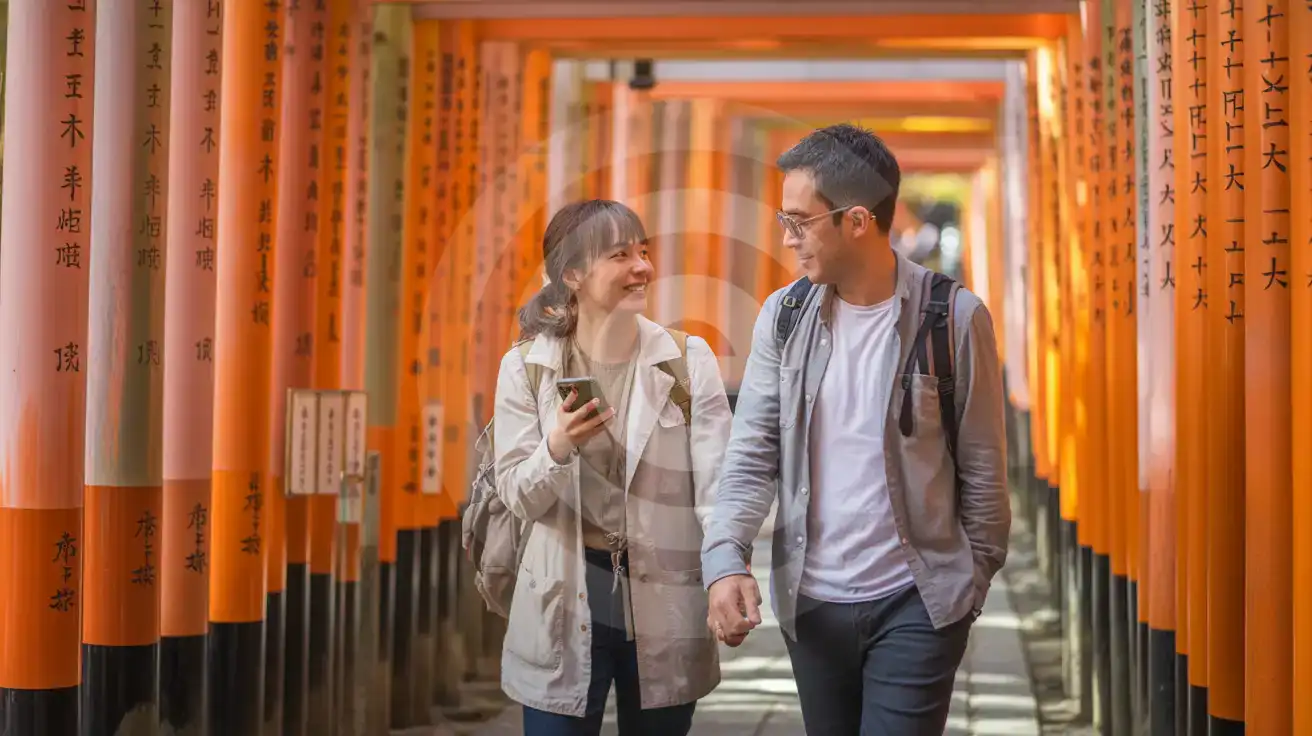
Beyond transit, data unlocks experiences that would otherwise require a Japanese phone number or local knowledge. The Ghibli Museum in Mitaka sells tickets exclusively through Lawson convenience stores using a Japanese-language terminal—or through the official site, which sends QR confirmations to your email. TeamLab Borderless in Odaiba, Universal Studios Japan in Osaka, and Fushimi Inari's quieter dawn visits all benefit from timed-entry bookings that load on your phone at the gate. eSIMno plans for Japan keep these QR codes accessible without hunting for café WiFi.
Food discovery runs on apps. Tabelog rates restaurants on a 5-point scale that locals trust more than Google reviews. Hot Pepper Gourmet handles reservations at izakayas that don't answer calls from foreign numbers. Gurunavi shows English menus where available. Even convenience store runs improve with data—7-Eleven's tax-free counter needs passport scans plus a digital receipt flow that assumes connectivity. From the sushi counter in Tsukiji to the ramen shops lining Ichiran's Tenjin branch in Fukuoka, your phone is the bridge between hunger and a seat.
Tokyo absorbs most first-time visitors with its collision of neon and tradition—Shibuya Scramble Crossing handles 3,000 pedestrians per light cycle, while Sensō-ji has welcomed pilgrims since 645 AD. Kyoto moves slower, its 2,000+ temples and machiya townhouses preserved along the Philosopher's Walk and inside the bamboo corridors of Arashiyama Bamboo Grove. Osaka is the eating capital—takoyaki stalls in Dotonbori District, Michelin-starred kaiseki in Kitashinchi, and morning tuna auctions at Kuromon Market. Hokkaido draws powder chasers to Niseko's 15 meters of annual snowfall and summer road-trippers to Furano's lavender fields and Biei's patchwork hills.
Cherry blossoms pull visitors in late March through mid-April, when Ueno Park and Maruyama Park in Kyoto turn pink and locals picnic beneath the branches. Autumn leaves peak from mid-November in Kyoto's temple gardens—Tofukuji's 2,000 maple trees and Eikando's evening illuminations. Ski season runs December through March in Nagano, Niigata, and Hokkaido resorts. Year-round draws include onsen towns like Hakone (90 minutes from Tokyo via Romancecar), the deer and Great Buddha of Nara, Hiroshima's Peace Memorial Park, and the tropical beaches of Okinawa's Kerama Islands.
Spring (March–May) and autumn (October–November) offer mild weather and peak scenery. Summer (June–August) brings humidity, festivals like Gion Matsuri in Kyoto, and fewer crowds at mountain destinations. Winter (December–February) means world-class skiing, illuminations across Tokyo, and hot-spring soaking with snow falling outside the rotenburo.
Narita International Airport sits 60 km east of central Tokyo. The Narita Express (N'EX) reaches Tokyo Station in 53 minutes and Shinjuku in 80 minutes; fares run around ¥3,000-¥3,500 one-way. The Access Express via Keisei Skyliner covers the same route faster (36 minutes to Ueno) at similar cost. Haneda Airport is closer—the Tokyo Monorail reaches Hamamatsucho in 13 minutes, and Keikyu trains connect to Shinagawa in 11 minutes for under ¥500. Kansai International Airport serves Osaka, Kyoto, and Nara; the Haruka Express reaches Kyoto Station in 75 minutes for around ¥2,000-¥3,000.
The bullet train network ties the country together. Tokyo to Kyoto takes 2 hours 15 minutes on the Nozomi; Tokyo to Osaka adds another 15 minutes. The JR Pass—purchased before arrival—covers most JR trains including many shinkansen routes, making multi-city itineraries economical. Regional trains handle last-mile connections: the Kintetsu line from Kyoto to Nara (35 minutes), the Hankyu line from Osaka-Umeda to Kyoto-Kawaramachi (40 minutes), and the Sanyo Shinkansen extension to Hiroshima (4 hours from Tokyo).
IC cards (Suica, Pasmo, ICOCA) work on virtually all trains, subways, and buses nationwide—tap in, tap out, fares deduct automatically. Mobile Suica through Apple Pay or Google Pay lets you reload anywhere with a data connection. Taxis are metered and honest but expensive; base fares start around ¥500-¥700 for the first 1-2 km. Uber operates in Tokyo and Osaka but with limited coverage compared to Western cities. GO Taxi is the dominant local rideshare app—Japanese interface, but the map-based pickup works without language.
 Recommended Recommended | Local SIM / Operator | Roaming | |
|---|---|---|---|
| FEATURES | |||
| Setup time | Few minutes | Store visit + paperwork | Auto |
| No local ID needed | Online checkout | Local ID required | Use home account |
| Speed | 4G/5G | Carrier-grade | Partner-dependent |
| Travel support | English support 24/7 | Japanese only | Home carrier hours |
| Keep home number | Dual SIM | Replaces it | Same number |
| Cost predictability | Fixed price | Bills can spike | Bill-shock risk |
| PRICING | |||
Typical pricing | See plans below | Cheap but Japanese support only | $12-18 / day Typical day-pass tariff varies by home carrier |
No more SIM kiosks
Skip the airport queues. Install your eSIM at home, activate when you land.

No roaming surprises
Forget the $200 phone bill three weeks after your trip. Plain pricing, no hidden fees.

Keep your home number
Dual-SIM means your physical SIM stays active for calls and texts. eSIM handles only data.

Setup in 2 minutes
Scan QR code, follow on-screen steps, you're connected. Works on any eSIM-compatible phone.


Experience seamless global connectivity with our personal eSIM service. Enjoy faster speeds, wider coverage, and the convenience of online purchasing.

Buy a Data Plan
Search for your destination and pick any data plan
Step 1
Install your eSIM
Easy installation via qr code
Step 2
Activate Your eSIM
Only active when you are ready to use data
Step 3
24/7 Customer Support
Reach our team via WhatsApp and email during business hours. Quick answers to common questions available anytime through our automated assistant.
Immediate delivery
Your eSIM arrives by email within minutes. Install it before you board your flight.
Worldwide Coverage
One eSIM, 160+ countries. Land anywhere and connect instantly — no SIM swapping, no roaming charges.
Check Compatibility
Before buying and installing an eSim, check if your phone supports one
As you feel the need to use eSIM on your phone, the first question that arises is: does your mobile support eSIMs? And do eSIM-compatible devices work in all regions worldwide?
Find helpful information to answer your questions

Refer
A FRIEND
Step into the world of E-SIM, bring your friends and benefit together!