
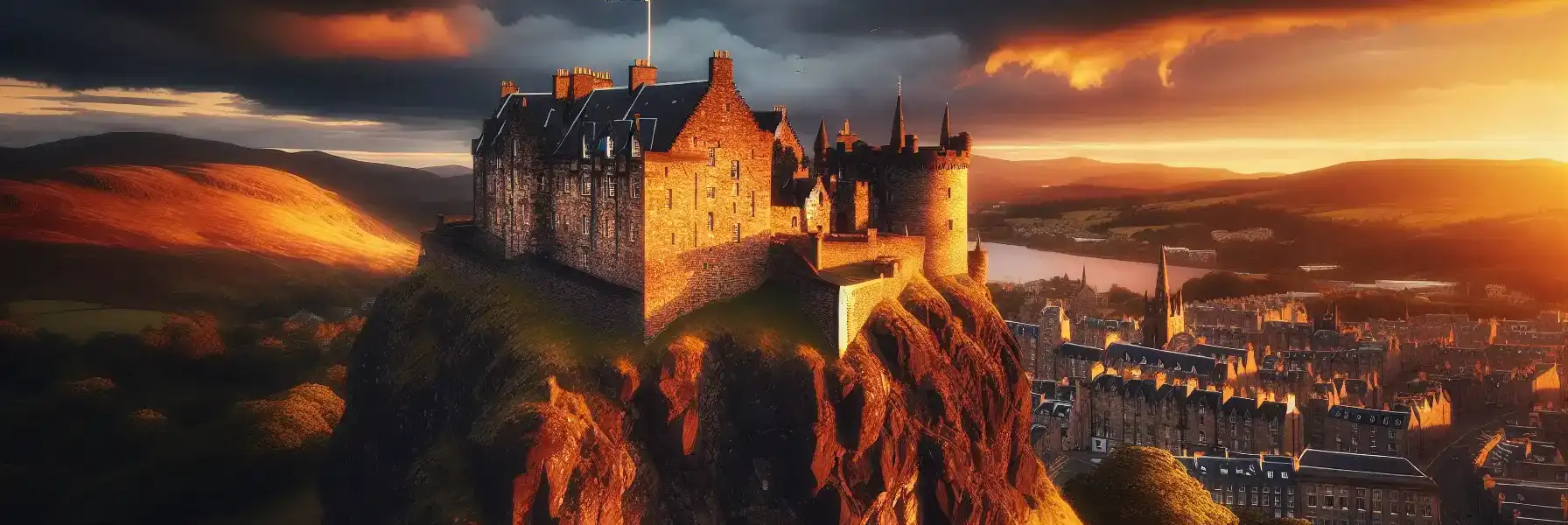
Quick Facts
- Address
- Castlehill, Edinburgh EH1 2NG
- Hours (Apr-Sep)
- 09:30-18:00 daily (last entry 17:00)
- Hours (Oct-Mar)
- 09:45-17:00 daily (last entry 16:00)
- Adult Admission
- £20-£22 (online booking required)
- Child (5-15)
- Reduced rate; under 5 free
- Nearest Station
- Edinburgh Waverley (10-15 min walk)
- Nearest Tram
- Princes Street stop
- Official Site
- historicenvironment.scot
- UNESCO Status
- Part of Old & New Towns of Edinburgh (1995)
- eSIMno Networks
- Everything Everywhere, O2, Three
About Edinburgh Castle
Castle Rock is an extinct volcanic plug that last erupted approximately 350 million years ago, and humans have fortified its summit since at least the Iron Age. The first documented royal castle on the site belongs to King Malcolm III and his queen, Saint Margaret, who made it a residence in the late 11th century. Their son, King David I, is credited with building St Margaret's Chapel around 1130 — a small Romanesque structure that remains the oldest surviving building in Edinburgh today.
The fortress changed hands repeatedly during the Wars of Scottish Independence. Edward I of England seized it in 1296; William Wallace's forces recaptured it in 1297; Edward took it again in 1298. The most celebrated recapture came in 1314 when Thomas Randolph, Earl of Moray, led a small party up the north face of Castle Rock at night to surprise the English garrison. Robert the Bruce subsequently ordered the defences slighted — deliberately destroyed — to prevent the English from using them again. Much of what visitors see today dates from rebuilding efforts after that destruction.
Mary, Queen of Scots gave birth to the future James VI of Scotland (later James I of England) in the castle's Royal Apartments on 19 June 1566. The small chamber where the birth occurred, barely large enough for a bed, remains one of the most emotionally charged spaces within the complex. The Lang Siege of 1571-1573, fought between supporters of Mary and those of her infant son, left the castle in ruins once more. The distinctive Half Moon Battery, which now dominates views from Princes Street, rose from that destruction.
The castle transitioned from royal residence to military garrison by the 17th century, a role it maintained for over 300 years. Jacobite forces briefly held it in 1715 and besieged it unsuccessfully in 1745. Victorian-era restorations, particularly under architect Hippolyte Blanc in the 1880s and 1890s, romanticised medieval elements while preserving the military character. The Scottish National War Memorial, designed by Sir Robert Lorimer and opened in 1927, added a contemplative dimension that honours the castle's martial history while transcending it.
Today the castle is owned by the Scottish Ministers and managed by Historic Environment Scotland. It anchors the western end of the Royal Mile and serves as the ceremonial heart of Edinburgh's August festival season, with the Esplanade hosting the Royal Edinburgh Military Tattoo. The fortress remains an active military site: the headquarters of the Royal Regiment of Scotland and the 52nd Infantry Brigade occupy buildings within its walls. This dual identity — heritage attraction and working military installation — gives Edinburgh Castle a vitality that purely museum-ified fortresses lack.
Highlights & Must-See
The Honours of Scotland and the Stone of Destiny
The Crown Room within the Royal Palace on Crown Square houses Scotland's greatest treasures. The Honours of Scotland — comprising the crown, sceptre, and sword of state — are the oldest crown jewels in the British Isles, predating the English regalia by over a century. The crown was refashioned for James V in 1540 using gold from the previous Scottish crown, set with 22 gemstones and 20 freshwater Scottish pearls. The sceptre, gifted by Pope Alexander VI to James IV in 1494, features a polished globe of rock crystal. The sword of state, presented by Pope Julius II in 1507, bears etched images of Saints Peter and Paul. Mary, Queen of Scots was crowned with these Honours in 1543 when she was nine months old.
Beside the Honours rests the Stone of Destiny (Stone of Scone), the ancient coronation stone of Scottish kings. Kenneth MacAlpin brought it to Scone in the 9th century; Edward I seized it in 1296 and installed it beneath the Coronation Chair at Westminster Abbey. The stone returned to Scotland on St Andrew's Day 1996, 700 years after its removal. Its presence here carries profound symbolic weight — this rough block of red sandstone has witnessed the making of Scottish monarchs for over a millennium.
The Great Hall
James IV completed the Great Hall around 1511 on the south side of Crown Square, and its hammerbeam roof remains one of the finest medieval timber ceilings in Scotland. The hall served as the meeting place for the Scottish Parliament and hosted state banquets until the 17th century, when it was partitioned into barracks accommodation. Victorian restorers removed the partitions and lined the walls with arms and armour — swords, polearms, pistols, and muskets arranged in decorative patterns. The original fireplace, large enough for a person to stand in, anchors the east wall. Morning light through the tall windows illuminates the carved wooden angels supporting the hammerbeams.
St Margaret's Chapel
This tiny Romanesque chapel near the highest point of Castle Rock is Edinburgh's oldest building, dating to approximately 1130. King David I likely built it to honour his mother, Saint Margaret, who died at the castle in 1093. The interior measures barely three metres by five metres. The chancel arch features characteristic Norman chevron decoration; five stained-glass windows added in the 1920s depict Saint Margaret, Saints Columba and Ninian, Saint Andrew, and William Wallace. The chapel holds services on certain Sundays and remains a popular venue for small weddings — couples must book years in advance.
Mons Meg
The six-tonne medieval bombard sits on a terrace outside St Margaret's Chapel, its barrel now silent but once capable of hurling 150-kilogram gun-stones nearly two miles. Philip the Good, Duke of Burgundy, gifted the weapon to James II in 1457. It saw action at various Scottish sieges before its barrel burst during a celebratory firing in 1681. The English carried it to the Tower of London in 1754; Sir Walter Scott successfully campaigned for its return in 1829. The sheer mass of the bombard — over five metres long with a bore of 50 centimetres — makes it one of the largest medieval cannons surviving anywhere in Europe.
The One O'Clock Gun and Mills Mount Battery
Every day except Sunday, Good Friday, and Christmas Day, a gunner from 105th Regiment Royal Artillery fires the One O'Clock Gun from Mills Mount Battery at precisely 13:00. The tradition began in 1861 as a time signal for ships in the Firth of Forth — captains could see the gun smoke and set their chronometers accordingly. Today it remains Edinburgh's most punctual daily ritual. The battery itself offers panoramic views northward over the New Town, Princes Street Gardens, and toward the Firth of Forth. Arrive by 12:50 to secure a position with a clear sightline.
The National War Museum
Located in the former hospital building on the west side of Crown Square, the National War Museum traces 400 years of Scottish military history. Exhibits include regimental colours, campaign medals, personal effects of soldiers, and weapons ranging from 17th-century basket-hilted swords to 20th-century field artillery. The museum provides essential context for understanding why Edinburgh Castle remained an active military installation long after most European fortresses became purely ceremonial.
The Scottish National War Memorial
Sir Robert Lorimer's memorial, opened in 1927 on the north side of Crown Square, commemorates Scottish casualties from the First World War, with subsequent extensions honouring those lost in later conflicts. The interior features stained glass, bronze friezes, and regimental shrines surrounding a central casket containing the Rolls of Honour listing the names of the fallen. Photography is not permitted inside, and visitors are asked to maintain silence. The architectural restraint and cumulative emotional weight make this one of the most affecting war memorials anywhere in Britain.
The Royal Apartments
The small suite of rooms where Mary, Queen of Scots gave birth to James VI occupies part of the Royal Palace on Crown Square. The birth chamber itself is tiny — barely larger than a closet — with reproduction furnishings evoking the 16th century. Adjacent rooms display historical panels explaining the complex politics surrounding James's birth and Mary's subsequent downfall. The intimacy of the space, contrasted with the momentous dynastic consequences of the birth that occurred here, creates a peculiar tension.
Visit Strategy
Ticket Strategy
Edinburgh Castle operates timed-entry ticketing, and walk-up availability is often sold out, particularly from May through September. Book online via the Historic Environment Scotland website at least a week in advance during peak season — during the August festival period, two weeks is safer. Adult tickets cost approximately £20-£22; Historic Scotland Explorer Pass holders and Historic Scotland members enter free. The Explorer Pass pays for itself if you're visiting three or more Historic Scotland properties during your trip (Stirling Castle and the Palace of Holyroodhouse are popular combinations).
Audio guides cost an additional £3.50-£4 and are available in multiple languages including Mandarin, Japanese, French, German, Spanish, and Italian. They're worth it for first-time visitors, particularly for interpreting the Crown Room and understanding the complex history of the Great Hall. Free guided tours led by castle stewards depart regularly from near the Argyle Battery — look for guides in period-inspired costumes gathering groups every 20-30 minutes.
Best Time to Visit
The 09:30 first entry slot is the quietest time to experience the castle, particularly the Crown Room. By 11:00, tour bus groups begin arriving, and the queue for the Honours of Scotland extends out the door. The final 90 minutes before closing also thin out considerably, though you'll be walking against the flow of visitors rather than with it. Weekdays outside August are noticeably calmer than weekends year-round.
If you want to witness the One O'Clock Gun, plan your route so you're at Mills Mount Battery by 12:50. The firing happens whether or not anyone is watching, and it's over in seconds — being in the wrong part of the castle at 13:00 means hearing a distant boom rather than seeing the gunner and the smoke.
Recommended Duration
Allow two to three hours for a thorough visit. This gives you time to explore the Crown Room without rushing, linger in St Margaret's Chapel, absorb the war memorials, and photograph the views from multiple batteries. If you're taking the audio guide, budget toward the three-hour end. Speed-walkers can see the highlights in 90 minutes, but the castle rewards slower exploration.
Mobility Considerations
The castle sprawls across multiple levels connected by steep, uneven cobbled paths. The climb from the entrance gate to Crown Square at the summit involves significant elevation gain. Visitors with mobility impairments can request the free courtesy vehicle, which runs from the entrance to Crown Square — ask at the ticket office. However, even with vehicle access, some areas involve steps that cannot be avoided. Comfortable footwear with good grip is essential for everyone; the cobbles are slippery when wet.
August Festival Period
During the Royal Edinburgh Military Tattoo (typically the first three weeks of August), the Esplanade transforms into a temporary 8,600-seat stadium. This affects castle access in several ways: parts of the Esplanade may be closed during afternoon setup; evening approaches become impossible once the performance begins; and overall visitor numbers in Edinburgh spike dramatically. The castle itself remains open during normal daytime hours, but expect heavier crowds and book tickets further in advance than you otherwise would.
Photography Rules
Personal photography is permitted throughout most of the castle, including the Great Hall, St Margaret's Chapel, Mons Meg, and all outdoor batteries. Photography is prohibited inside the Crown Room where the Honours of Scotland and Stone of Destiny are displayed — this is strictly enforced. Photography is also prohibited inside the Scottish National War Memorial, where silence is requested as a mark of respect. Tripods and commercial photography require prior permission from Historic Environment Scotland.
Best Time to Visit & Photographer's Guide
Month-by-Month Crowd & Weather
January-February: The quietest months, with visitor numbers at their annual low. Temperatures hover between 1-7°C, and daylight is limited (sunrise around 08:30, sunset around 16:30). The castle often appears dramatic against grey skies, with occasional snow dusting the battlements. Expect rain — Edinburgh averages 12-14 rainy days per month in winter.
March-April: Shoulder season begins. Crowds remain manageable, particularly on weekdays. Temperatures rise to 5-12°C, and longer daylight hours (by April, sunrise is around 06:00) allow for early morning photography before the castle opens. Easter brings a visitor spike.
May-June: Peak season builds. Temperatures reach 10-18°C, and Edinburgh enjoys some of its longest daylight hours — by late June, the sky remains light until nearly 22:00. Book tickets at least a week ahead. The gardens below the castle bloom, adding colour to photographs from Princes Street Gardens.
July-August: The busiest period, especially during the Edinburgh Festival Fringe and Military Tattoo (August). Temperatures peak at 12-20°C. Crowds are significant; the 09:30 entry is essential for any hope of contemplative exploration. The Tattoo transforms the Esplanade into a stadium, affecting certain photographic angles.
September-October: Crowds thin after the festivals end. September offers pleasant 10-16°C temperatures and autumn light that photographers prize — warm tones during golden hour, dramatic cloud formations. October brings increasing rain and cooler temperatures (7-13°C).
November-December: Off-season returns. The Edinburgh Christmas markets fill Princes Street Gardens, providing foreground interest for castle photographs. Temperatures drop to 3-8°C. The castle closes on Christmas Day and Boxing Day; reduced hours apply throughout winter.
Best Time of Day
Sunrise (from outside): The castle faces roughly north-south, so true sunrise light rarely strikes the facade directly. However, dawn from Calton Hill captures the castle silhouette against the brightening eastern sky with the Old Town rooftops below — one of Edinburgh's classic photographs. Summer sunrise around 04:30 requires dedication; winter sunrise around 08:30 is more accessible.
Golden Hour (evening): The western-facing Half Moon Battery and parts of the Royal Palace catch warm late-afternoon light, particularly from May through August when sunset approaches from the northwest. The classic viewpoint from Princes Street Gardens looks east toward the castle, meaning golden hour backlights the fortress rather than illuminating it directly — this creates dramatic silhouettes.
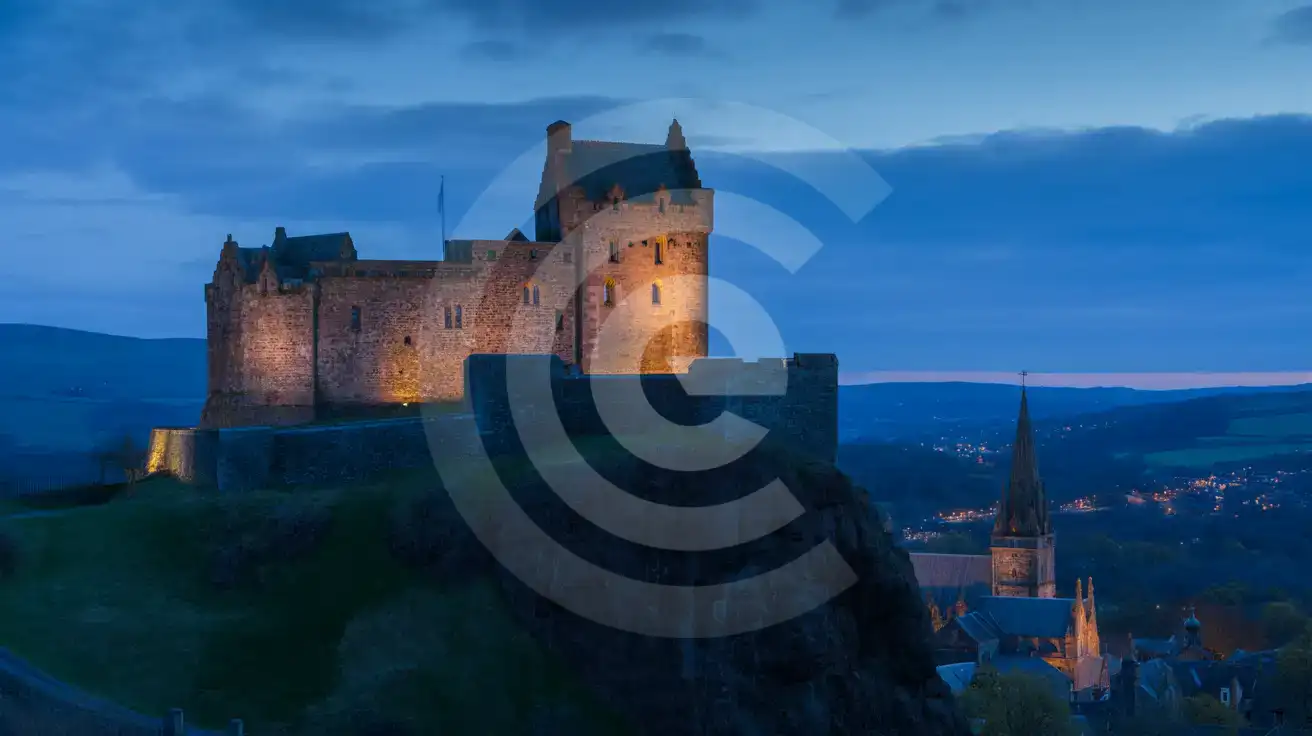
Blue Hour: The 30-45 minutes after sunset produce Edinburgh Castle's most atmospheric photographs. City lights begin to glow, the floodlights on the castle illuminate the stone, and the deep blue sky provides rich contrast. This is when the postcards are made. In summer, blue hour extends past 22:00; in winter, it arrives by 16:30.
Inside the castle: Morning light through the Great Hall's east-facing windows creates the best interior illumination, roughly 10:00-12:00 from March through September. St Margaret's Chapel, being small with narrow windows, is perpetually dim — high ISO photography is necessary.
Best Photo Spots
1. Princes Street Gardens (East): The definitive Edinburgh photograph. From the path below the Scott Monument, the castle rises above the treeline with the Gardens' manicured lawns in the foreground. Blue hour with floodlighting is unbeatable.
2. Calton Hill: The 15-minute climb to the summit provides the classic panoramic view of Edinburgh, with the castle at the western end of the Old Town ridge. Best at sunrise when haze sits in the valleys.
3. The Vennel Steps: This narrow stairway off the Grassmarket offers a dramatic low-angle view of the castle's southern fortifications through a gap in the buildings. The framing is tight and compositionally striking.
4. Grassmarket: The square below the castle's southern rock face provides wide-angle photographs with pubs and colourful storefronts in the foreground. Best in afternoon light when shadows define the castle's stone texture.
5. Johnston Terrace: The road winding below the castle's western walls offers close-up perspectives of the fortifications without tourist crowds. Early morning, before traffic builds, works best.
6. Mills Mount Battery (inside): For interior shots, the view from Mills Mount looking north over the city captures both the One O'Clock Gun and the panorama toward the Firth of Forth. The rampart walls provide foreground interest.
7. King's Knot from St Cuthbert's Churchyard: This lesser-known angle from below the castle's northern face, accessible through the churchyard at the west end of Princes Street, offers intimate views of the rock face with gravestones adding historic texture to the foreground.
Drone & Tripod Rules
Drone flights over Edinburgh Castle are prohibited without explicit permission from Historic Environment Scotland and compliance with Civil Aviation Authority regulations. The castle sits within a complex airspace that includes the flight paths for Edinburgh Airport (13 km away) and helicopter operations. Penalties for unauthorized drone use are significant. Tripods are permitted inside the castle grounds for personal photography but cannot be used inside buildings or in any location that impedes visitor flow. Commercial photography and filming require advance permission and usually involve fees.
Hidden Sub-Spots Most Tourists Miss
The Dog Cemetery: Near the summit, a small patch of grass contains the graves of regimental mascots and officers' pets buried between 1840 and 1987. The tiny headstones, some with touching inscriptions, offer a humanising counterpoint to the martial grandeur surrounding them.
St Margaret's Chapel Interior at Quiet Moments: Most visitors peer through the doorway without entering. Step fully inside during a lull between tour groups, and the Romanesque simplicity — the chevron arch, the pale stone, the coloured light from the stained glass — reveals itself properly.
The Western Defences: Beyond the main visitor circuit, the path along the western fortifications toward the back of the National War Museum sees far fewer visitors than Crown Square. The views toward the Pentland Hills reward the extra steps.
Foog's Gate: The arched passage below the Portcullis Gate contains medieval stonework that predates most of the visible castle. Most visitors walk through without pausing; stopping to examine the 14th-century masonry rewards attention.
The Lang Stairs: This steeply climbing stone stairway between the Argyle Battery and Crown Square is often bypassed in favour of the gentler curved path. Taking the Lang Stairs puts you directly below the Half Moon Battery, where the scale of the fortifications becomes viscerally apparent.
Nearby Attractions & Logistics
The Royal Mile
The Royal Mile stretches downhill from the castle's Esplanade through Lawnmarket, High Street, and Canongate to the Palace of Holyroodhouse — approximately 1.6 kilometres of continuous medieval street frontage. Budget 10-15 minutes to walk the length without stopping, though the reality involves pauses at shop windows, closes (the narrow alleyways leading off the main street), and historic plaques. St Giles' Cathedral, the High Kirk of Edinburgh, lies roughly ten minutes downhill from the castle gate. Its crown steeple is visible from the Esplanade; inside, the Thistle Chapel designed by Sir Robert Lorimer (the same architect responsible for the castle's War Memorial) features intricate Gothic Revival woodcarving.
The Scotch Whisky Experience
Immediately adjacent to the castle on Castlehill, this attraction offers guided tours explaining whisky production, a barrel ride through a mock distillery, and tastings from Scotland's various whisky regions. The gift shop claims one of the world's largest collections of Scotch whisky bottles. Allow 90 minutes for the standard tour.
Camera Obscura and World of Illusions
Also on Castlehill, this Victorian attraction has occupied its tower since 1853. The rooftop camera obscura — a live projection of the city streets onto a white viewing table — offers a unique perspective and panoramic views. The lower floors contain optical illusions and interactive exhibits. Popular with families; expect queues in summer.
The National Museum of Scotland
A 12-minute walk from the castle via George IV Bridge to Chambers Street brings you to Scotland's national museum. Admission is free. The collections range from the Lewis Chessmen and the Monymusk Reliquary (a 7th-century house-shaped shrine) to industrial design, natural history, and world cultures. The rooftop terrace offers another angle on the castle's silhouette. Budget at least two hours; dedicated museum-goers could spend a full day.
Princes Street Gardens
The gardens occupy the drained valley of the former Nor Loch, the lake that once protected the castle's northern approach. A 10-minute walk down the Mound from the castle entrance brings you to paths winding through lawns and flowerbeds, with the Scott Monument — a 61-metre Gothic spire honouring Sir Walter Scott — rising from the eastern section. The views back up to Castle Rock from the gardens are among Edinburgh's most photographed perspectives.
Getting to Edinburgh Castle
From Edinburgh Waverley railway station, the castle is a 10-15 minute walk uphill. Exit onto Princes Street and walk west, then turn left up the Mound and follow it to Lawnmarket, where you'll turn right onto the Royal Mile heading toward the Esplanade. Alternatively, exit via Market Street and climb through Cockburn Street to reach the High Street. Lothian Buses serving Lawnmarket, George IV Bridge, and Johnston Terrace stop within a few minutes' walk of the Esplanade. The Edinburgh Tram stops at Princes Street, from which the walk uphill takes approximately 15 minutes. There is no dedicated parking at the castle; the nearest public car parks are on Castle Terrace (approximately 500 spaces) and at the St James Quarter on the east side of the New Town.
Suggested Day Itinerary
Begin with the 09:30 entry to Edinburgh Castle. Spend two to three hours exploring, timing your exit to watch the One O'Clock Gun from Mills Mount. Walk down the Royal Mile, stopping at St Giles' Cathedral around 13:30. Lunch options along Victoria Street or in the Grassmarket offer everything from Scottish pub fare to contemporary restaurants — The Witchery by the Castle, immediately beside the Esplanade, serves theatrical fine dining for those wanting proximity to where you started. Spend the afternoon at the National Museum of Scotland (free admission makes popping in for even an hour worthwhile). Finish with a walk through Princes Street Gardens to the Scott Monument as late-afternoon light catches the castle from below, or climb Calton Hill for sunset views encompassing the castle, Arthur's Seat, and the Firth of Forth.
Why Data Matters at Edinburgh Castle
Edinburgh Castle sprawls across a volcanic summit connected by steep cobbled paths and medieval stairways — the kind of terrain where pulling out a paper map while balancing on uneven stone becomes a minor hazard. Having reliable mobile data transforms the visit in practical ways. The official Historic Environment Scotland app includes interactive maps showing exactly where the Crown Room, Great Hall, and St Margaret's Chapel sit relative to your current position. The audio guide, if you choose to download it rather than rent a device, requires connectivity at the entrance.
Beyond navigation, data matters for the spontaneous moments: checking whether the National Museum of Scotland closes before you'll finish at the castle, confirming your dinner reservation at a Royal Mile restaurant, or sharing that perfect Mills Mount photograph while the gun smoke still hangs in the air. The castle's stone walls and internal courtyards create inconsistent WiFi coverage — relying on venue-provided connectivity is a gamble.
An eSIMno plan connecting through Everything Everywhere, O2, or Three provides consistent coverage across the castle grounds, the Royal Mile approach, and throughout Edinburgh's Old and New Towns. You activate it before leaving home, land at Edinburgh Airport already connected, and avoid the queue at mobile shops while tourists around you squint at offline maps trying to find the One O'Clock Gun.
Edinburgh Castle at Blue Hour
Compare WiFi Options at Edinburgh Castle
 Recommended Recommended | Local SIM / Operator | Roaming | |
|---|---|---|---|
| FEATURES | |||
| Setup time | Few minutes | Store visit + paperwork | Auto |
| No local ID needed | Online checkout | Local ID required | Use home account |
| Speed | 4G/LTE; 5G in some areas | Carrier-grade | Partner-dependent |
| Travel support | English support 24/7 | Operator shops and call centre | Home carrier hours |
| Keep home number | Dual SIM | Replaces it | Same number |
| Cost predictability | Fixed price | Bills can spike | Bill-shock risk |
| PRICING | |||
Typical pricing | See plans below | — | — |
PRICING — PICK YOUR ESIMNO PLAN
Destination overview
Frequently Asked Questions
Featured eSIM plans
BritMobile

BritMobile
BritMobile
BritMobile
BritMobile
BritMobile
BritMobile
BritMobile