




No more SIM kiosks
Skip the airport queues. Install your eSIM at home, activate when you land.


Land connected. No SIM kiosk hunt, no roaming charges, no setup at the airport. One plan covers your whole trip.
 Spain / Alicante
Tell us what you'll do and how long you'll be away — we'll highlight the right plan.
What will you do?

Alicante runs on real-time apps the moment you clear customs. The TRAM Metropolitano L1 line connects the airport to Luceros station in 35 minutes with departures every 20 minutes during peak hours, but the platform display boards lag behind the live schedule — Google Maps or Moovit with real-time data keeps you from stranding yourself during the 40-minute off-peak gaps. Cabify and Uber both serve the airport pickup zone at Door 1 arrivals, but surge pricing spikes when cruise ships dock at the Port of Alicante marina; checking both apps before you commit can save €8-12 on the same route to your Barrio Santa Cruz guesthouse.
Connectivity stays essential across the city's core. The Explanada de España promenade stretches 500 meters along the waterfront with free municipal WiFi, but signal drops the moment you step into the Mercado Central building — and that's exactly where you need Google Translate for the seafood stall menus. Santa Bárbara Castle sits 166 meters above sea level on Mount Benacantil; the hilltop ticket scanner requires your timed-entry QR code, and the castle's own WiFi barely reaches the ramparts. Download your confirmation email before the steep climb, or trust your eSIMno plans for Alicante, Spain to load it on demand.
Beyond the historic center, Postiguet Beach has zero public WiFi — booking a chiringuito table for sunset drinks means mobile data or nothing. The Alicante Archaeological Museum (MARQ) uses QR-code audio guides that stream over your connection; lobby WiFi is congested during school-group visits. Even the ferry to Tabarca Island (22 km offshore, 1-hour crossing) takes mobile bookings that load faster on cellular than the port terminal's overloaded network. Your eSIM keeps working whether you're navigating the Barrio Santa Cruz alleyways, catching the L3 TRAM to El Campello, or extending your trip to Valencia or Barcelona on the same plan.
Barrio de Santa Cruz climbs the slopes beneath Santa Bárbara Castle, its whitewashed houses and narrow staircases tumbling toward the waterfront. This is the historic core — tapas bars, ceramic-tiled plazas, and the 14th-century Basílica de Santa María anchoring the upper reaches. Downhill, the Centro district spreads around the Mercado Central, a 1921 Modernist market hall where locals queue for fresh gambas and jamón. The Explanada de España promenade connects the marina to the beach, its wave-pattern marble tiles drawing evening paseos from families and couples alike. Playa de San Juan, 6 km northeast via the L4 TRAM, stretches 3 km with calmer crowds than central Postiguet — the trade-off is a 15-minute ride instead of a 5-minute walk.
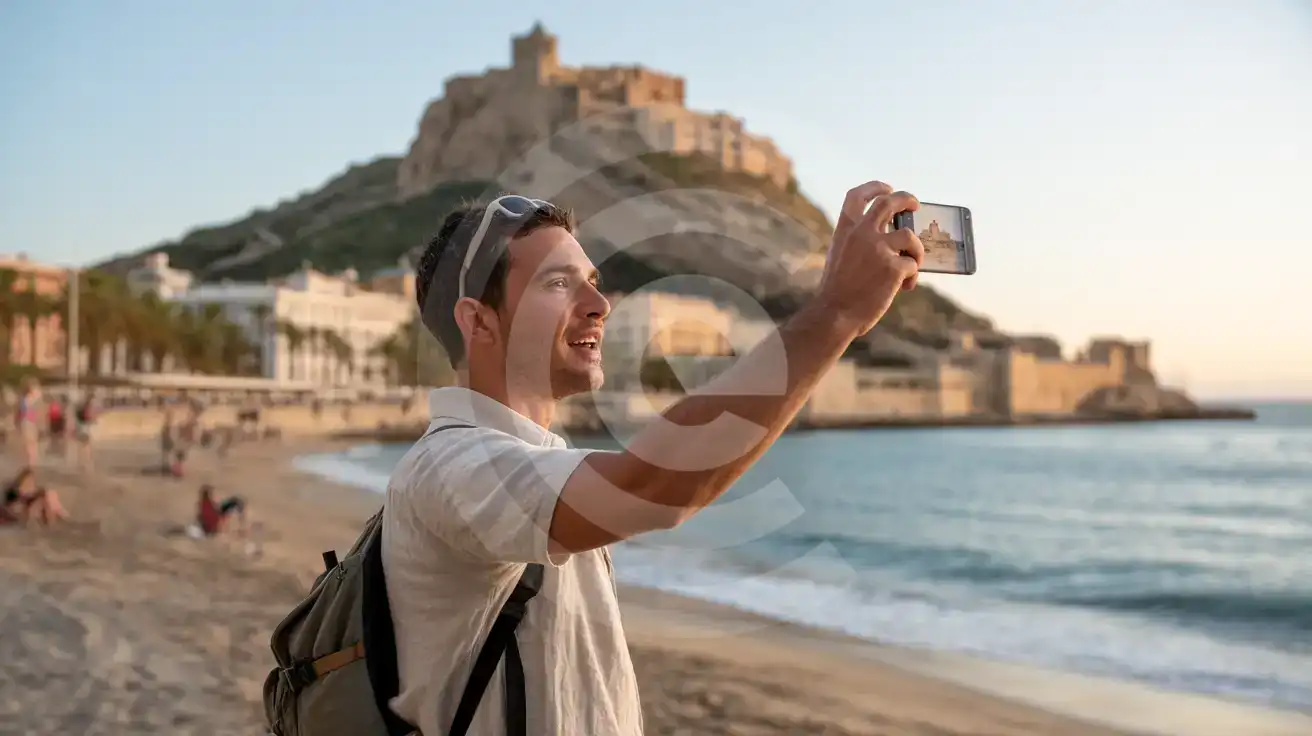
The Castle of Santa Bárbara dominates every Alicante photograph, its medieval walls offering 360-degree views from Cabo de las Huertas to the distant Sierra de Aitana. Sunrise visits beat the midday heat and the tour-group crush. Postiguet Beach sits directly below the castle rock, a 400-meter crescent of calm Mediterranean water ideal for morning swims before the beach bars open. The Archaeological Museum of Alicante (MARQ) houses Iberian and Roman artifacts in a restored hospital building near the train station — QR-code audio guides stream context for each gallery. Day-trippers head inland to Guadalest Valley, a mountain reservoir village 45 minutes northwest, or south to Elche's UNESCO-listed palm groves (25 km, 30-minute drive).
Alicante averages 300 sunny days per year. July and August bring peak beach crowds and temperatures above 30°C; hotel rates climb 40-60% above shoulder-season baseline. May-June and September-October deliver warm swimming weather (22-26°C), thinner crowds at Santa Bárbara Castle, and lower Cabify surge multipliers during evening tapas hours.
Alicante-Elche Miguel Hernández Airport (ALC) sits 9 km southwest of the city center. The TRAM L1 line runs from the airport station to Luceros in the Centro district in 35 minutes, with departures every 20 minutes during peak hours and every 40 minutes off-peak. A single ride costs around €3.50; contactless payment works at the platform validators. Cabify and Uber pickups wait at Door 1 arrivals — expect €18-25 to Barrio Santa Cruz depending on traffic and surge. Taxis queue outside Door 2 with metered fares running €20-28 to the city center.
The TRAM Metropolitano network covers Alicante and the northern Costa Blanca coast. Line L1 connects Luceros to Benidorm (70 minutes, useful for day trips). Line L3 runs to El Campello beaches (25 minutes). Line L4 reaches Playa de San Juan (15 minutes). Fares depend on zones crossed; a T10 multi-ride card offers savings for repeat trips. Real-time schedules display on the Moovit and Google Maps apps — platform boards update slower than the apps.
The Centro district, Barrio Santa Cruz, and Postiguet Beach all cluster within a 1.5 km walkable radius. Cobblestone streets and steep staircases make rolling luggage awkward in the old quarter — rideshare from the train station is worth the €5-7 fare. Cabify handles most trips; Uber coverage is patchier outside the airport and marina zones. Lime e-scooters dot the Explanada promenade and unlock via app — a useful bridge between the marina and Mercado Central without the uphill slog.
 Recommended Recommended | Local SIM / Operator | Roaming | |
|---|---|---|---|
| FEATURES | |||
| Setup time | Few minutes | Store visit + paperwork | Auto |
| No local ID needed | Online checkout | Local ID required | Use home account |
| Speed | 4G/5G | Carrier-grade | Partner-dependent |
| Travel support | English support 24/7 | Valencian only | Home carrier hours |
| Keep home number | Dual SIM | Replaces it | Same number |
| Cost predictability | Fixed price | Bills can spike | Bill-shock risk |
| PRICING | |||
Typical pricing | See plans below | — | $12-18 / day Typical day-pass tariff varies by home carrier |
No more SIM kiosks
Skip the airport queues. Install your eSIM at home, activate when you land.

No roaming surprises
Forget the $200 phone bill three weeks after your trip. Plain pricing, no hidden fees.

Keep your home number
Dual-SIM means your physical SIM stays active for calls and texts. eSIM handles only data.

Setup in 2 minutes
Scan QR code, follow on-screen steps, you're connected. Works on any eSIM-compatible phone.


Experience seamless global connectivity with our personal eSIM service. Enjoy faster speeds, wider coverage, and the convenience of online purchasing.

Buy a Data Plan
Search for your destination and pick any data plan
Step 1
Install your eSIM
Easy installation via qr code
Step 2
Activate Your eSIM
Only active when you are ready to use data
Step 3
24/7 Customer Support
Reach our team via WhatsApp and email during business hours. Quick answers to common questions available anytime through our automated assistant.
Immediate delivery
Your eSIM arrives by email within minutes. Install it before you board your flight.
Worldwide Coverage
One eSIM, 160+ countries. Land anywhere and connect instantly — no SIM swapping, no roaming charges.
Check Compatibility
Before buying and installing an eSim, check if your phone supports one
As you feel the need to use eSIM on your phone, the first question that arises is: does your mobile support eSIMs? And do eSIM-compatible devices work in all regions worldwide?
Find helpful information to answer your questions

Refer
A FRIEND
Step into the world of E-SIM, bring your friends and benefit together!