
Quick Facts
- Founded
- 778 CE (current buildings 1633)
- Hours
- 6:00 AM – 6:00 PM daily (extended during illuminations)
- Admission
- 500 yen adults / 200 yen students
- Address
- 1-294 Kiyomizu, Higashiyama-ku, Kyoto
- Nearest Bus Stop
- Gojo-zaka or Kiyomizu-michi (routes 100, 206)
- Nearest Train Station
- Kiyomizu-Gojo (Keihan Line) — 20 min walk
- UNESCO Status
- World Heritage Site since 1994
- Official Website
- kiyomizudera.or.jp
- eSIMno Networks
- KDDI
About Kiyomizu-dera
The founding story of Kiyomizu-dera begins in 778 CE with a wandering priest named Enchin, who reportedly followed a golden stream through the forested hills east of the ancient capital until he discovered the Otowa Waterfall cascading from the mountainside. Enchin established a small hermitage at the site, naming it for the kiyoi mizu — the pure water — that flowed there. Within two decades, the warrior-statesman Sakanoue no Tamuramaro visited the site while hunting deer for his ailing wife. After an encounter with Enchin that convinced him to abandon hunting, Tamuramaro became the temple's principal patron, funding the construction of its first major halls around 798 CE and dedicating it to Kannon, the bodhisattva of compassion.
The temple's early centuries saw it grow into one of the most important pilgrimage sites in the Kyoto region. But fire proved as constant a companion as devotion. The complex burned repeatedly — in 1063, 1165, 1469, and 1629 — each time rising again from the ashes. The current main hall and surrounding structures date from a comprehensive reconstruction completed in 1633 under the patronage of Tokugawa Iemitsu, the third Tokugawa shogun. This 17th-century rebuilding produced the architectural masterpiece visitors experience today, including the legendary wooden stage.
Kiyomizu-dera's institutional identity has evolved as dramatically as its buildings. For most of its history, the temple belonged to the Hosso sect of Buddhism, headquartered at Kofuku-ji in Nara. In 1965, however, the temple established its own independent school — Kita-Hosso — effectively becoming the mother temple of its own Buddhist lineage. This unusual step reflected both the temple's massive popularity and its desire for administrative independence.
The principal object of worship remains an eleven-headed, thousand-armed Kannon statue classified as a hibutsu, or 'hidden Buddha.' This sacred image is displayed to the public only once every 33 years — a cycle that corresponds to the 33 manifestations of Kannon described in the Lotus Sutra. The most recent unveiling occurred in 2000, meaning the next opportunity falls in 2033. For pilgrims walking the Saigoku Kannon route — a circuit of 33 temples across western Japan established in the 8th century — Kiyomizu-dera serves as the 16th station, one of the most visited stops on the entire pilgrimage.
UNESCO recognized Kiyomizu-dera's significance in 1994, inscribing it on the World Heritage List as part of the 'Historic Monuments of Ancient Kyoto' grouping that includes 16 other sites across Kyoto, Uji, and Otsu. The temple also came close to international recognition of a different sort in 2007, when it was named a finalist in the New Seven Wonders of the World campaign. Today, Kiyomizu-dera receives over 5 million visitors annually, making it consistently one of Kyoto's two or three most-visited attractions alongside Fushimi Inari-Taisha and Kinkaku-ji.
Highlights & Must-See
The Hondo and the Wooden Stage (Butai)
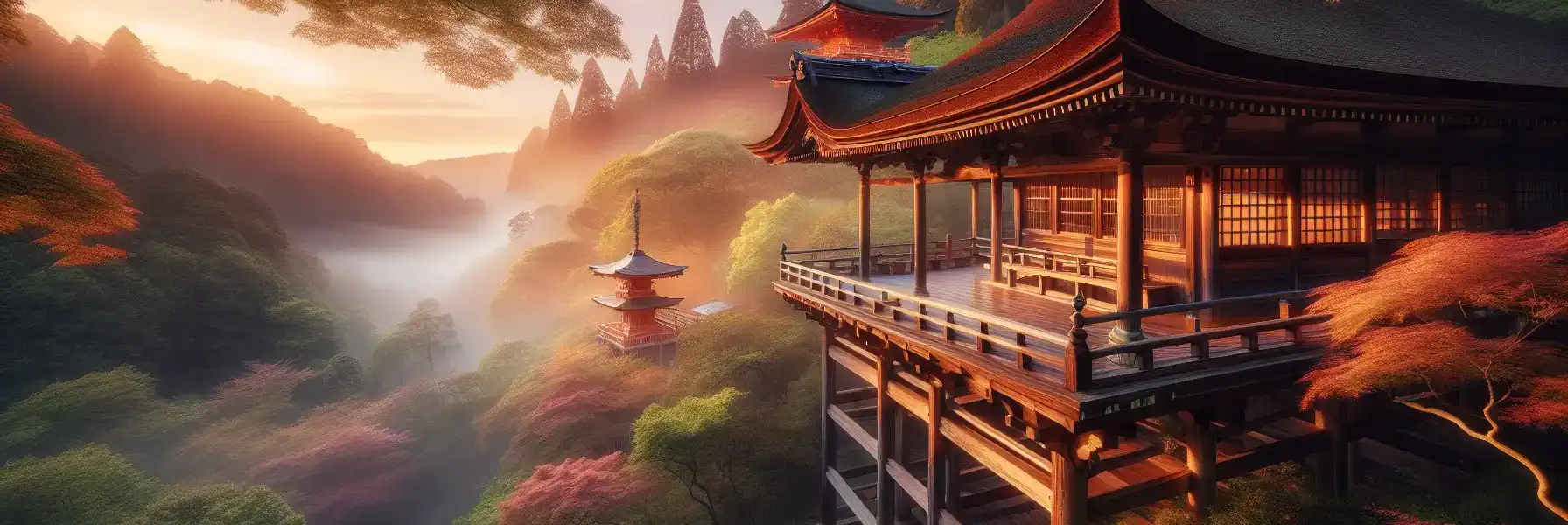
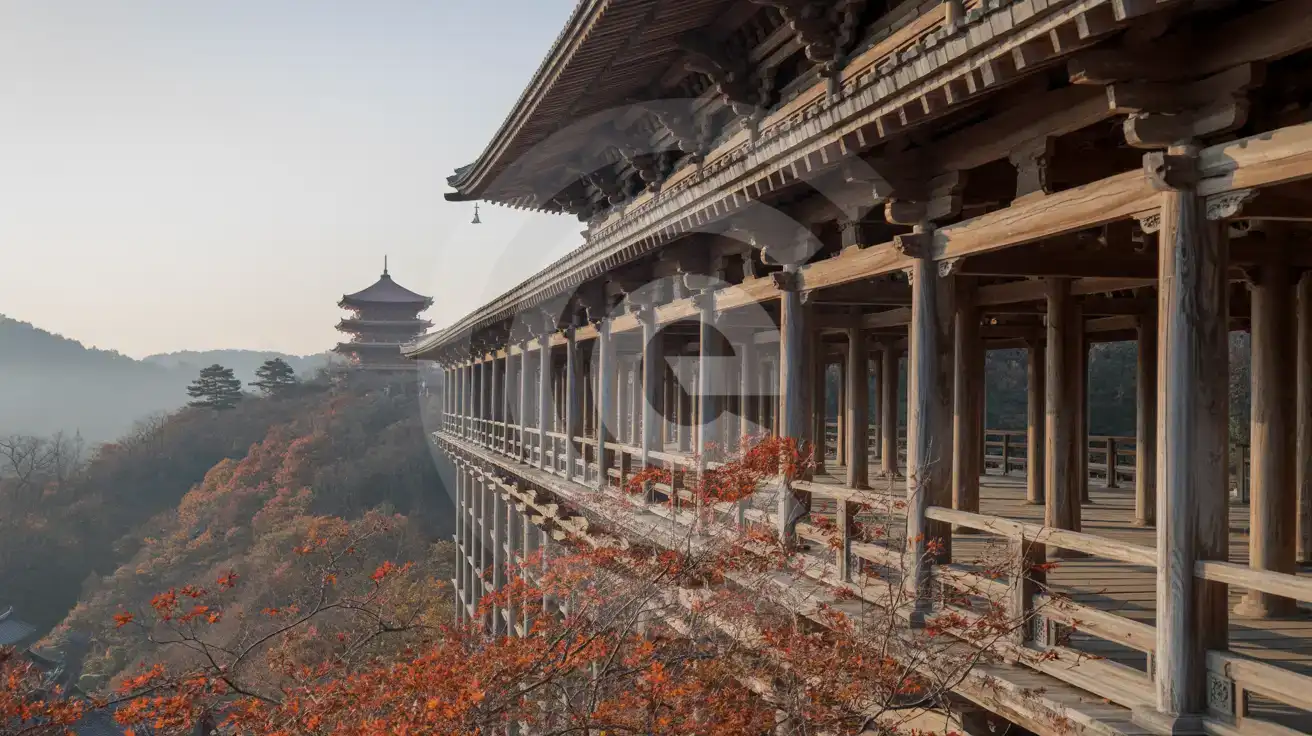
The Hondo, or main hall, is designated a National Treasure of Japan and houses the sacred Kannon image that draws pilgrims from across the country. But for most visitors, it's the butai — the broad wooden stage projecting from the Hondo's front — that defines the Kiyomizu experience. This platform extends roughly 190 square metres over the hillside, supported by 168 massive keyaki (zelkova) pillars that rise 13 metres from the valley floor. The entire structure is assembled using traditional kigumi joinery techniques, meaning the pillars, beams, and floorboards interlock without a single iron nail.
Standing on the stage, you look out over the temple's three-storied pagoda, the wooded Otowa valley, and the distant rooftops of central Kyoto. During cherry blossom season, pink petals drift past the railings; in autumn, the view transforms into a tapestry of orange, red, and gold maples. The Japanese expression Kiyomizu no butai kara tobioriru — 'to jump off the stage of Kiyomizu' — means to take a leap of faith, a decisive and irreversible action. Records from the Edo period suggest that some people took this literally, with over 200 documented jumps between 1694 and 1864. (Survival rate: approximately 85%. The practice is now forbidden.)
Otowa Waterfall (Otowa-no-taki)
Below the main hall, the Otowa Waterfall — the namesake spring that drew Enchin to this hillside 1,250 years ago — still flows from the mountainside in three separate streams. Visitors queue along a stone platform, using long-handled metal cups to catch water from whichever stream they choose. Tradition assigns different blessings to each: longevity, success in studies, and fortune in love. The catch? You're supposed to choose only one stream and take only a single sip. Drinking from all three, according to local belief, is considered greedy and negates the blessing entirely.
Jishu Shrine
Tucked directly behind the Hondo, Jishu Shrine predates the Buddhist temple and is dedicated to Okuninushi, a Shinto deity associated with love, matchmaking, and happy marriages. The shrine's most famous feature is a pair of 'love stones' (koi uranai no ishi) set approximately 18 metres apart. Visitors attempt to walk from one stone to the other with their eyes closed. Arriving successfully is said to predict luck in romance; needing a friend's guidance along the way supposedly indicates you'll need help finding love in real life. The shrine compound can get chaotically crowded with young visitors during peak seasons.
Three-Storied Pagoda (Sanjunoto)
Standing approximately 31 metres tall with its vermilion paint and copper-tiled roof, the Sanjunoto is one of the tallest three-storied pagodas in Japan and perhaps the most photographed structure in all of Kyoto. It sits on the approach slope above the Nio-mon (Deva Gate), framing views of the main hall from below. The pagoda dates to the 1632 reconstruction and is designated an Important Cultural Property. You cannot enter or climb the pagoda, but it serves as the iconic foreground element in most classic Kiyomizu photographs, especially those taken from the Okunoin observation area across the valley.
Okunoin Hall and Koyasu Pagoda
Across the wooded valley from the main stage, a winding path leads to Okunoin Hall — a smaller structure that offers the definitive photographic viewpoint of the Hondo cantilevered above the trees. This is where professional photographers set up during illumination events, and it's the angle that appears on most postcards. Nearby, the vermilion Koyasu Pagoda ('Easy Childbirth Pagoda') has been a destination for expectant mothers seeking safe deliveries for centuries. The walk from the main hall to Okunoin and back adds about 15-20 minutes to your visit but provides essential perspective on the main hall's dramatic engineering.
Nio-mon (Deva Gate) and Sai-mon (West Gate)
The approach to Kiyomizu-dera passes through several gates, the most imposing being the two-storied Nio-mon, flanked by fierce wooden guardian figures. Above it, the vermilion Sai-mon (West Gate) marks the western boundary of the temple grounds. Both date to the Edo-period reconstruction and are classified as Important Cultural Properties. The area between these gates offers excellent views back down toward the city and serves as a natural rest point before the final climb to the Hondo.
Zuigu-do (Tainai Meguri)
For visitors seeking something beyond the main sights, the Zuigu-do hall offers tainai meguri — a ritual 'womb passage' through complete darkness. Participants descend a stone staircase into the basement of the hall, then navigate through pitch-black corridors by following a handrail and touching carved Buddhist symbols along the wall. The experience symbolizes spiritual rebirth under the guidance of Zuigu Bosatsu, the mother of the Buddha. A separate 100 yen fee applies.
Bell Tower (Shoro)
Near the pagoda, the temple's bell tower houses a massive bronze bell cast in the 17th century. Unlike many temple bells struck only on special occasions, visitors can sometimes hear this bell ring at regular intervals throughout the day. The wooden frame of the tower, with its unpainted natural timber, contrasts beautifully with the vermilion pagoda and gates elsewhere on the grounds.
Visit Strategy
Timing Your Arrival
Kiyomizu-dera opens at 6:00 AM year-round, and this early window is the single most important factor in visit quality. At opening, you'll share the wooden stage with a handful of early risers — photographers, serious pilgrims, and a few travelers who did their homework. By 9:00 AM, the first tour buses begin unloading at Gojo-zaka. By 10:00 AM, the main stage becomes a shuffling crowd. By noon, photographing anything without strangers in frame becomes essentially impossible.
If you can't manage a 6:00 AM start, the second-best window falls in the final 60-90 minutes before closing. Late afternoon light casts long shadows across the stage, and the crowds thin as tour groups head to dinner. Weekdays in any season draw fewer visitors than weekends.
Seasonal Considerations
Cherry blossom season (late March to early April) and autumn foliage season (mid-November to early December) are the temple's busiest periods — and arguably its most beautiful. During these windows, the temple extends its hours for special evening illuminations, typically running until 9:00 PM. Thousands of visitors pack the grounds after dark to see the maple trees or cherry blossoms lit by spotlights, with the illuminated pagoda reflected in temporary ponds created for the effect.
For those seeking quieter visits, January and February offer the lightest crowds. Snow occasionally dusts the rooftops, creating stunning photographs for those willing to brave the cold. June — Kyoto's rainy season — also sees fewer visitors, though the humidity and frequent showers require waterproof gear. The summer months (July and August) bring heat, humidity, and Obon holiday crowds.
Tickets and Entry
Standard admission costs 500 yen for adults and 200 yen for elementary and junior-high students. You can only purchase tickets on-site; there is no advance booking system for regular visits. The ticket booth sits near the entrance to the main hall complex, past the free-to-access approach paths and gates. Special illumination events sometimes require separate tickets sold at higher prices.
There are no discount days or free admission periods. The entire temple complex typically requires 60-90 minutes for a thorough visit, though photographers and contemplative visitors often spend 2-3 hours.
Photography Rules
Outdoor photography is permitted throughout the grounds — on the main stage, around the pagoda, at Otowa Waterfall, and along all approach paths. Inside the Hondo, near the principal Kannon altar and inner sanctuary, photography is strictly prohibited. Clear signage marks these restricted areas. Tripods are generally tolerated in early morning and late afternoon when crowds are thin but may draw staff attention during peak hours when they impede pedestrian flow.
Physical Demands
Reaching Kiyomizu-dera requires walking uphill from any bus stop or train station. The most common approach — from the Gojo-zaka or Kiyomizu-michi bus stops — involves a 10-12 minute climb along Kiyomizu-zaka, a shop-lined slope with moderate gradient. Stone steps and uneven surfaces appear throughout the temple grounds. The main stage itself has level wooden flooring. Wheelchair access is extremely limited; most of the historic structures predate accessibility requirements. Visitors with mobility concerns should inquire at the temple office about available routes.
Dress Code and Etiquette
Kiyomizu-dera does not enforce a formal dress code like some religious sites — shorts, T-shirts, and casual wear are acceptable. However, comfortable walking shoes are essential given the slopes, stairs, and wooden floors. Shoes stay on throughout most of the grounds; removal is only required in specific inner halls where entry is permitted (such as the Zuigu-do). At the Otowa Waterfall, wait your turn patiently in line and avoid taking excessive time with the water cups.
Best Time to Visit & Photographer's Guide
Month-by-Month Crowd & Weather
January–February: Kyoto's coldest months bring temperatures between 1°C and 9°C, occasional snow dustings, and the year's lightest crowds. Morning fog sometimes fills the valley below the stage, creating ethereal conditions for photographers. Dress warmly — the wooden stage offers no shelter from the wind.
March–April: Cherry blossom season peaks typically in the first week of April. Crowds surge dramatically. Evening illuminations draw thousands. Temperatures warm to 10-18°C, with occasional spring rain. This is peak visitor season alongside November.
May–June: Fresh green foliage covers the hillside. May offers pleasant temperatures (15-25°C) and moderate crowds before rainy season arrives in June. The tsuyu (rainy season) runs roughly mid-June through mid-July, bringing humidity and frequent showers. Visitor numbers drop noticeably.
July–August: Summer heat pushes temperatures above 30°C with high humidity. Obon holiday (mid-August) brings domestic tourist crowds and special illumination events. Morning visits become essential for comfort. Hydration stations appear near the main approach.
September–October: Early autumn remains warm (20-28°C in September, 15-22°C in October) with comfortable visiting conditions. Crowds build gradually toward November's foliage peak.
November–December: Autumn foliage peaks in the second half of November, transforming the hillside into a canvas of red and orange maple. This is the temple's most spectacular season and its most crowded. Evening illuminations run through early December. December quiets dramatically after the lights end, with temperatures dropping to 5-12°C.
Best Time of Day
Sunrise (6:00 AM opening): The golden hour light strikes the pagoda and main hall from the east, creating warm tones on the vermilion paint and wooden structures. Minimal shadows on the stage. Almost no visitors. This is the definitive photography window.
Mid-morning (8:00-10:00 AM): Light becomes harsher, crowds arrive. Acceptable for casual photography but increasingly difficult to capture clean compositions.
Midday (11:00 AM – 2:00 PM): Overhead sun creates harsh shadows. Maximum crowd density. Avoid unless you have no alternative.
Golden hour (4:00-6:00 PM): Warm afternoon light returns, hitting the main hall from the west. Crowds thin toward closing. The second-best window for serious photography.
Blue hour / Night (illumination events only): During special seasonal openings, artificial lighting transforms the temple. The spotlit pagoda against a deep blue twilight sky, maples glowing beneath directed lights — these images require illumination event tickets and patience with dense crowds.
Best Photo Spots
1. The Main Stage (Butai): The classic view looking northeast toward the pagoda and the Kyoto skyline beyond. Works in any light but peaks at sunrise.
2. Okunoin Hall Viewpoint: Across the valley, this spot delivers the iconic photograph of the Hondo cantilevered above the trees. Bring a telephoto lens (100-200mm equivalent) to compress the perspective.
3. Below the Stage (Valley Floor Path): A trail descends below the Hondo, looking up at the 168 pillars. This unusual angle reveals the engineering achievement in a way the stage view cannot. Less crowded than above.
4. Pagoda Approach (Near Nio-mon): The vermilion pagoda framed by the temple gates, with seasonal foliage on either side. Classic postcard composition.
5. Sannenzaka / Ninenzaka Streets: Looking back uphill toward the temple through the preserved machiya lanes. The Yasaka Pagoda from Ninenzaka (technically a different structure) is Kyoto's most-photographed street scene.
6. Koyasu Pagoda Area: The small vermilion pagoda with the main hall complex visible across the valley. Quieter than other viewpoints.
7. Otowa Waterfall Queue: Visitors with long-handled cups against the cascading water — a scene that captures the pilgrimage tradition in action. Respect others' space while shooting.
Drone & Tripod Rules
Drones are prohibited throughout the temple grounds without explicit advance permission, which is rarely granted. Japanese aviation law also restricts flights over populated areas and within certain distances of airports. Tripods are tolerated during low-traffic periods (early morning, late afternoon) but become impractical during crowded hours. Staff may ask you to move if your equipment blocks pedestrian flow. Monopods offer a lower-profile alternative.
Hidden Sub-Spots Most Tourists Miss
Joju-in Garden: This sub-temple garden, usually open only during special seasonal periods, features a pond reflecting the borrowed scenery of the main hall. Check the temple website for opening dates.
The Stone Stairway Behind Jishu Shrine: Most visitors exit Jishu Shrine the way they entered. A secondary path behind the shrine leads to quiet stone steps through forest — less photogenic but peaceful.
Zuigu-do Basement Darkness: The tainai meguri passage through complete darkness offers no photography opportunities but provides a meditative experience most visitors skip entirely.
Nishi Otani Mausoleum Path: The temple's rear exit leads toward Nishi Otani, the mausoleum of Shinran (founder of Jodo Shinshu Buddhism). The forested path between the two sites sees almost no foot traffic.
Early Morning Bell Sounds: Arrive at opening and you may hear the temple bell ring from the Shoro — a sound that carries across the empty valley in a way impossible to experience amid daytime crowds.
Nearby Attractions & Logistics
Sannenzaka and Ninenzaka
The natural descent from Kiyomizu-dera follows Sannenzaka ('Three-Year Slope') and Ninenzaka ('Two-Year Slope'), two preserved stone-paved lanes lined with traditional machiya townhouses converted into tea shops, ceramic stores, and sweets vendors. The names derive from an old superstition: fall on Sannenzaka and you'll face three years of bad luck; fall on Ninenzaka and it's two years. Watch your step on the uneven stones. The entire walk from the temple gate through both lanes takes 20-30 minutes at a leisurely pace, longer with stops for matcha, yatsuhashi cinnamon sweets, or Kiyomizu-yaki pottery.
Yasaka Pagoda (Hokan-ji)
Rising above the rooftops of Ninenzaka, the five-storied Yasaka Pagoda — properly called Hokan-ji — is one of Kyoto's most photographed landmarks. The pagoda dates to 1440 and stands 46 metres tall. You can occasionally enter the ground floor for a small fee. The street view from Ninenzaka with the pagoda centered above the traditional houses has become one of Japan's most recognizable images.
Kodai-ji Temple
Roughly 10 minutes' walk north along the Higashiyama slope, Kodai-ji was founded in 1606 by Nene (Kita no Mandokoro), the widow of the warlord Toyotomi Hideyoshi. The temple contains some of the finest surviving examples of Momoyama-period maki-e lacquerware, including pieces personally used by Hideyoshi and Nene. The gardens, attributed to the legendary designer Kobori Enshu, include a moss-and-rock composition and a bamboo grove. Evening illuminations during cherry blossom and autumn foliage seasons rival those at Kiyomizu-dera, often with smaller crowds.
Yasaka Shrine and Maruyama Park
Continuing north from Kodai-ji, you reach Maruyama Park — Kyoto's most popular cherry blossom viewing spot — and Yasaka Shrine, the vermilion-gated Shinto shrine that anchors the Gion district. Yasaka Shrine hosts the Gion Matsuri each July, one of Japan's three great festivals. The walk from Kiyomizu-dera to Yasaka Shrine takes approximately 25-30 minutes at a relaxed pace, passing through some of Kyoto's most atmospheric streets.
Getting There from Kyoto Station
Kiyomizu-dera has no direct rail connection. From Kyoto Station, take Kyoto City Bus route 100 or 206 to Gojo-zaka or Kiyomizu-michi (approximately 15-20 minutes depending on traffic, 230 yen). From the bus stop, walk uphill along Kiyomizu-zaka for roughly 10-12 minutes. Alternatively, from Kiyomizu-Gojo Station on the Keihan Line (useful if coming from Osaka or Fushimi Inari-Taisha), expect a 20-minute uphill walk. Taxis can drop passengers near the base of Kiyomizu-zaka but cannot enter the pedestrian approach zone.
Suggested Day Itinerary
Begin at Kiyomizu-dera at 6:00 AM opening. Spend 60-90 minutes on the grounds: the main stage, Otowa Waterfall, Okunoin viewpoint, Jishu Shrine. Descend through Sannenzaka and Ninenzaka as shops open, stopping for breakfast at one of the tea houses. Photograph Yasaka Pagoda. Continue to Kodai-ji for its gardens (about an hour). Walk through Maruyama Park to Yasaka Shrine. Enter the Gion district for lunch — the Hanami-koji lane of traditional tea houses lies minutes away. The full circuit covers roughly 3 kilometres and fills a comfortable half-day. Add Nijo Castle or Kinkaku-ji in the afternoon for a full Kyoto temple day.
Why Data Matters at Kiyomizu-dera
The temple itself offers no public WiFi, and the surrounding Higashiyama neighborhood — while charming — consists mostly of small shops without guest networks. Your phone becomes essential the moment you step off the bus at Gojo-zaka: Google Maps navigation up the winding approach lanes, translation apps for menu kanji at the tea houses, Google Lens to read temple signage, and camera storage that demands cloud backup when you've taken 200 photos of the same maple tree in different light.
KDDI's network provides solid LTE coverage throughout the temple grounds, including on the main stage and down in the valley near Otowa Waterfall. An eSIMno plan activates before you leave home, which means you're connected from Kansai International Airport through every photo-worthy moment on that 168-pillar stage. No hunting for SIM card shops at Kyoto Station, no awkward miming at convenience store counters. Real-time transit apps — Navitime or Japan Transit Planner — become critical for timing your bus back to the station or onward to Fushimi Inari-Taisha.
The illumination events present a particular connectivity challenge: thousands of visitors concentrated in a small area, all trying to upload photos simultaneously. A local carrier connection handles this congestion far better than international roaming or pocket WiFi devices competing for bandwidth.
The Wooden Stage Above the Valley
Compare WiFi Options at Kiyomizu-dera
 Recommended Recommended | Local SIM / Operator | Roaming | |
|---|---|---|---|
| FEATURES | |||
| Setup time | Few minutes | Store visit + paperwork | Auto |
| No local ID needed | Online checkout | Local ID required | Use home account |
| Speed | 4G/5G | Carrier-grade | Partner-dependent |
| Travel support | English support 24/7 | {0} only | Home carrier hours |
| Keep home number | Dual SIM | Replaces it | Same number |
| Cost predictability | Fixed price | Bills can spike | Bill-shock risk |
| PRICING | |||
Typical pricing | See plans below | — | — |
PRICING — PICK YOUR ESIMNO PLAN
Destination overview
Frequently Asked Questions
Yes, there are no bag restrictions or security checks at the temple entrance. However, large backpacks become cumbersome on the crowded main stage and narrow paths, especially during peak seasons. No lockers exist on-site, so consider leaving large luggage at your hotel or in Kyoto Station coin lockers before visiting.
Photography is prohibited inside the Hondo near the principal Kannon altar and inner sanctuary — clear signs mark these areas. All outdoor spaces, including the famous wooden stage, the pagoda exterior, and Otowa Waterfall, permit photography without restriction.
Regular daytime admission (500 yen) requires no advance booking — tickets are sold only at the gate. Special evening illumination events during cherry blossom and autumn foliage seasons sometimes offer advance tickets through the temple website, but same-day purchase is usually possible. Expect long queues during peak illumination nights.
No formal dress code applies. Unlike some stricter religious sites, Kiyomizu-dera welcomes visitors in casual clothing including shorts and T-shirts. Comfortable walking shoes are strongly recommended given the uphill approaches, stone steps, and wooden floors throughout the complex.
Technically yes, but tradition holds that you should choose only one stream — longevity, academic success, or love — and take a single sip. Drinking from all three is considered greedy and supposedly negates the blessing. Most visitors respect this custom.
Accessibility is extremely limited. The temple grounds involve steep slopes, stone steps, and historic wooden structures that predate modern accessibility standards. Some paved paths exist, but reaching the main hall and stage requires navigating stairs. Visitors with mobility concerns should contact the temple office in advance to ask about available routes.
Yes — KDDI and other major Japanese carriers provide solid LTE coverage throughout the temple grounds, including on the main stage and in the valley near Otowa Waterfall. An eSIMno plan running on KDDI keeps you connected for navigation, translation, and photo uploads without hunting for WiFi.
The temple ticket booth accepts cash (Japanese yen) only. Most shops and tea houses along the approach lanes accept cash; some larger establishments have started accepting IC cards (Suica, ICOCA) and credit cards, but cash remains the safest option in this traditional neighborhood.
Featured eSIM plans
Japan Mobile

Japan Mobile
Japan Mobile
Japan Mobile
Japan Mobile
Japan Mobile