
Quick Facts
- Founded
- 711 CE (relocated 816 CE)
- Hours
- Open 24 hours, year-round
- Admission
- Free
- Address
- 68 Fukakusa Yabunouchicho, Fushimi-ku, Kyoto 612-0882
- Nearest Station
- JR Inari (direct exit) or Keihan Fushimi-Inari (5-min walk)
- Trail Length
- 4 km round-trip to summit (233m elevation gain)
- Annual Visitors
- 10+ million
- eSIMno Networks
- KDDI
- Official Site
- inari.jp
About Fushimi Inari-Taisha
The history of Fushimi Inari-Taisha begins in 711 CE, when the Hata clan — a powerful immigrant family of Korean descent that controlled this region of what is now southern Kyoto — enshrined Inari Ōkami on the forested slopes of Mount Inari. The Hata had accumulated considerable wealth through silk production and sake brewing, and their choice to establish a shrine to the deity of rice, harvest, and prosperity reflected both agricultural pragmatism and spiritual devotion.
For over a century, the shrine occupied a position higher on the mountain before the monk Kūkai (posthumously known as Kōbō Daishi), founder of Shingon Buddhism, advocated for its relocation in 816 CE. Kūkai was constructing the great Tō-ji temple in Kyoto at the time and reportedly received timber from the Inari mountain forests for his building projects. The merger of Inari worship with Buddhist practice that Kūkai encouraged would persist until the Meiji government forcibly separated Shinto and Buddhism in 1868.
Imperial patronage came early and elevated the shrine to elite status. In 942 CE, Emperor Suzaku granted Fushimi Inari the highest rank among shrines, a designation that formalized what local devotion had already established. The Honden — the main sanctuary that houses the kami — carries Important Cultural Property status today, though the building visitors see dates to 1499. The original structures were destroyed during the Ōnin War (1467-1477), a decade-long conflict that reduced much of Kyoto to ashes and forced the shrine's reconstruction from foundation stones.
The vermilion paint that coats virtually every wooden surface at Fushimi Inari serves purposes both practical and spiritual. Traditionally, the color was believed to ward off malevolent forces and disease. It also represented abundant harvests and vital energy. The pigment itself — derived from mercury sulfide mixed with linseed oil — possesses preservative qualities that protect the wood from decay, which partially explains why structures survive despite Kyoto's humid summers and cold winters.
What distinguishes Fushimi Inari from Kyoto's other major shrines is its function as a headquarters. Approximately 30,000 Inari shrines exist throughout Japan, from tiny roadside hokora to substantial urban compounds, and all of them trace their spiritual lineage to this mountain. The foxes (kitsune) that visitors encounter as statues throughout the grounds are not objects of worship themselves but messengers of the deity — divine intermediaries who carry prayers between the human and spiritual realms. Their mouths hold symbolic objects: keys to the rice granary, jewels representing the spirit of the kami, scrolls of wisdom, or sheaves of rice representing the harvest.
Today, Fushimi Inari-Taisha welcomes over 10 million visitors annually, making it one of Japan's most visited religious sites. It regularly ranks as Kyoto's most popular destination in international travel surveys, though it notably was not included in the 1994 UNESCO inscription of 'Historic Monuments of Ancient Kyoto' — an omission that reflects bureaucratic categorization rather than historical importance. The shrine remains an active place of worship where business owners, merchants, and tradespeople donate vermilion torii gates as votive offerings, each inscribed with the donor's name and the date of dedication. The practice continues today, with new gates appearing regularly and old ones quietly removed when weathering makes them unsafe.
Highlights & Must-See
Romon Gate (Tower Gate)
The vermilion two-story gate at the main entrance sets the scale for everything that follows. Donated in 1589 by the warlord Toyotomi Hideyoshi — reportedly in gratitude after his mother recovered from illness — it stands as one of the largest shrine gates of its architectural type in Japan. The structure carries Important Cultural Property designation and frames the approach to the Honden with deliberate grandeur. Guardian fox statues flank the entrance, their stone expressions simultaneously welcoming and watchful. Most visitors pause here for photographs before ascending the stone steps beyond, but the gate rewards closer inspection: the carved details beneath the eaves and the proportions of the columns reflect the confidence of an era when Hideyoshi controlled most of Japan.
Honden (Main Hall)
Located directly behind the Romon Gate, the current Honden dates to 1499 and exemplifies the Nagare-zukuri architectural style — characterized by an asymmetrical gabled roof that extends forward over the worship space. Elaborate gold and polychrome carvings beneath the eaves depict auspicious symbols, though the interior where the kami resides remains hidden from view. This is where most visitors offer prayers, tossing coins into the offering box, bowing twice, clapping twice, and bowing once more in the standard Shinto prayer sequence. The shrine office adjacent to the Honden sells ema plaques shaped like fox faces, which visitors decorate themselves before hanging on designated racks. The goshuin desk here provides the main shrine's calligraphic stamp — one of several available along the mountain trail.
Senbon Torii (Thousand Torii Gates)
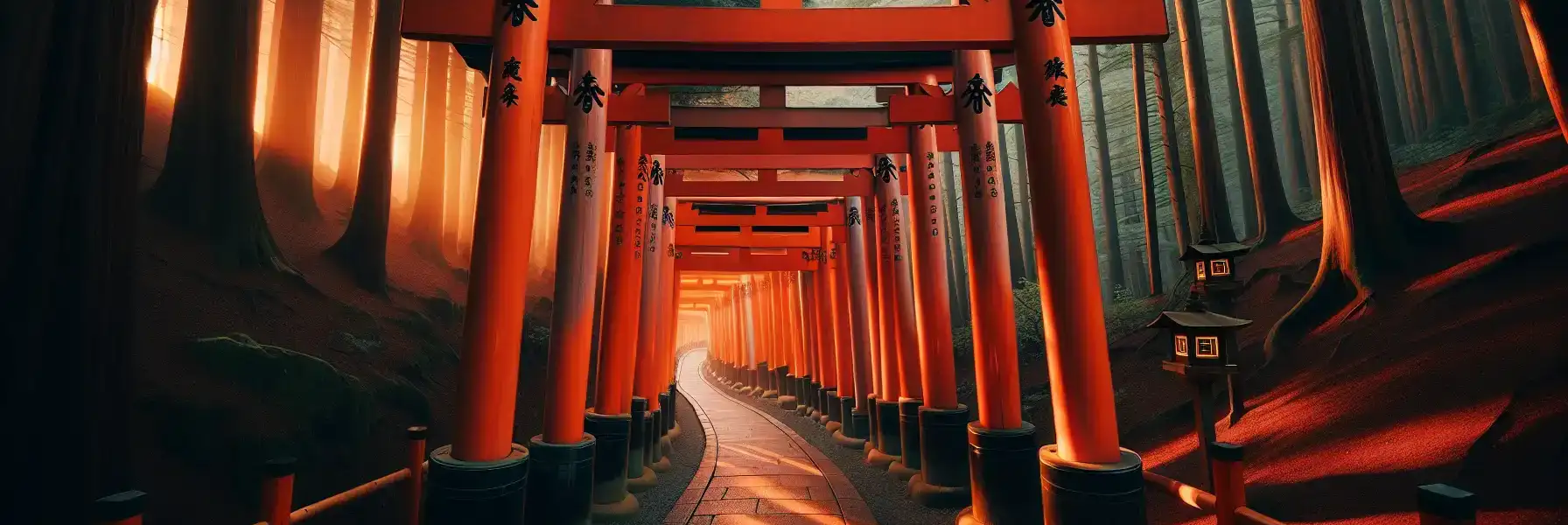
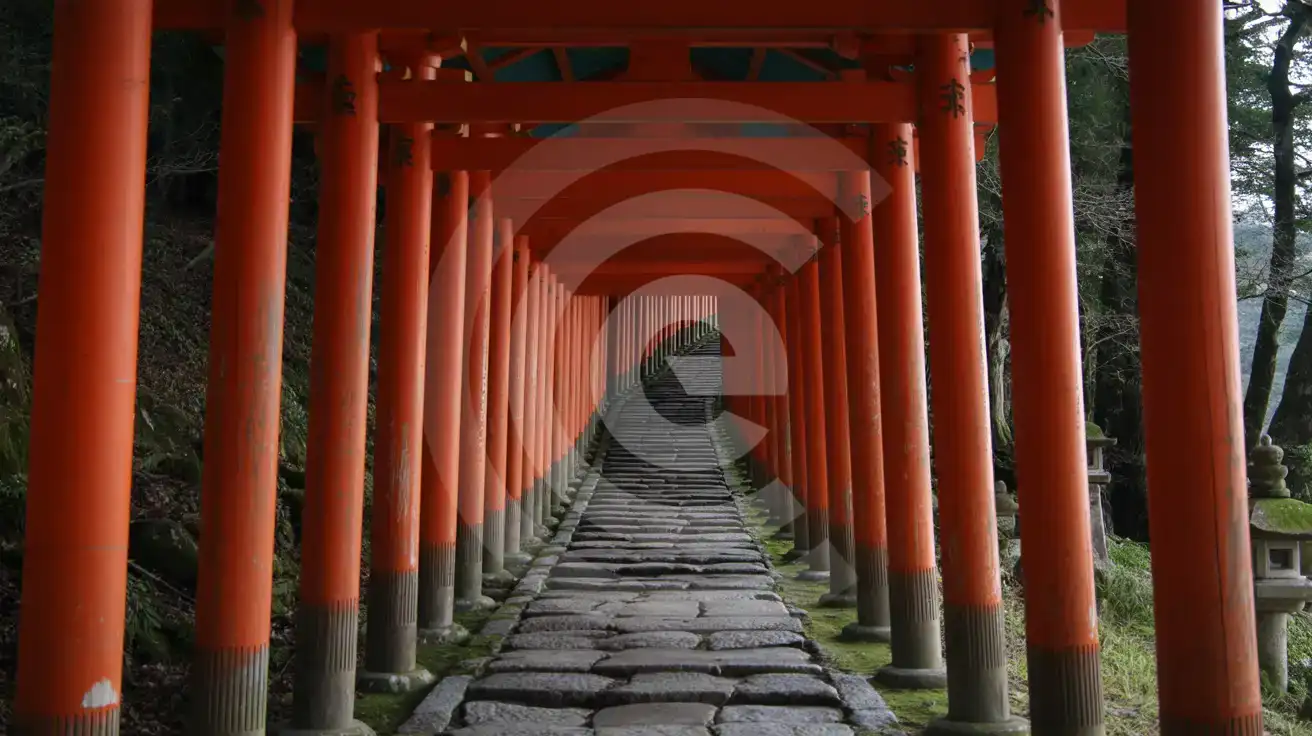
Behind the main shrine compound, the path splits into two parallel tunnels of densely packed vermilion torii gates leading uphill toward the Okusha Hōhaisho. This is the shrine's signature image — the photograph that appears on every Kyoto tourism poster and the scene that draws millions of visitors annually. The name 'Senbon' means 'thousand,' though the actual number of gates along the entire mountain exceeds 10,000. Each gate is inscribed on the reverse with the donor's name and the date of dedication; the smallest gates start around ¥400,000 and the largest exceed ¥1,000,000. The two parallel paths create a one-way flow during busy periods, though early morning visitors often have both tunnels to themselves.
Okusha Hōhaisho (Inner Shrine)
The first major rest point after the Senbon Torii, Okusha Hōhaisho marks the boundary between casual visiting and committed hiking. A small worship hall faces the mountain, and the walls display thousands of miniature torii offered by visitors who couldn't afford full-sized gates. The atmosphere shifts here — fewer tour groups, more individual pilgrims, and the first hints of the forest silence that characterizes the upper trails.
Omokaru-ishi (Lighter or Heavier Stones)
Behind the Okusha Hōhaisho sit a pair of stone lanterns topped with round stones that visitors use for divination. The ritual is simple: make a wish, then lift the stone. If it feels lighter than expected, your wish will come true. If it feels heavier, more effort will be required to achieve your goal. The practice draws steady queues during busy periods, and the smooth wear on the stones testifies to centuries of hopeful hands.
Yotsutsuji Intersection
Roughly halfway up Mount Inari, the Yotsutsuji intersection offers the trail's best panoramic view — a westward vista across southern Kyoto that reaches to the distant mountains on clear days. Most visitors who don't intend to complete the full circuit turn back here, making this a natural decision point. Small tea houses sell drinks and snacks, and benches allow rest before either the descent or the continued climb. The light is particularly good in late afternoon when the sun drops toward the horizon.
Otsuka Subsidiary Shrines
Above Yotsutsuji, the trail passes dozens of small subsidiary shrines called otsuka — mounds of stone markers, miniature torii, and offerings accumulated over generations. Each otsuka represents a personal or family devotion, often maintained by descendants of the original dedicators. The effect is cumulative and slightly overwhelming: foxes, gates, stones, incense smoke, and weathered inscriptions layer into a devotional landscape unlike anything in Kyoto's more manicured temple gardens.
Summit Plateau (Ichinomoine)
The peak of Mount Inari stands at 233 metres — modest by hiking standards but substantial when reached via stone steps from the base. The summit itself is anticlimactic in terms of views (trees block most sightlines), but the atmosphere rewards the effort. Fewer visitors make it this far, and those who do tend to be pilgrims rather than tourists. Several small shrines and tea houses cluster around the plateau, and completing the full circuit carries its own satisfaction.
Mountain Tea Houses
Scattered along the trail from Yotsutsuji to the summit, traditional tea houses offer rest stops with remarkable settings. Most sell soft drinks, bottled water, and light snacks; some offer more substantial fare like kitsune udon (fox noodles, served with sweet fried tofu said to be the fox messengers' favorite food). Prices run higher than at base level — a premium for carrying supplies up the mountain — but the experience of drinking cold tea while looking out over forested slopes and vermilion gates justifies the markup.
Visit Strategy
Timing Your Arrival
The single most important decision you'll make about Fushimi Inari is when to show up. The shrine operates 24 hours a day, every day of the year, which creates opportunities that most Kyoto attractions cannot offer. Early morning — before 7:00 AM — delivers the closest thing to solitude you'll find at Japan's most visited shrine. The Senbon Torii can occasionally be photographed empty at dawn, and the mountain trails above feel genuinely peaceful. By 9:00 AM, tour buses begin depositing groups at the main gate, and by 10:00 AM the lower paths become congested enough that photography requires patience and luck.
Evening visits offer a different kind of magic. After 5:00 PM, the crowds thin noticeably as day-trippers return to central Kyoto. By 7:00 PM in summer (earlier in winter), the trails are atmospherically lit by stone lanterns, and the vermilion gates glow against darkening skies. Night visits are safe on the lower sections — the path is well-maintained and the lantern lighting adequate — though the upper trails require a flashlight and more caution. The combination of empty paths and lantern light makes evening one of the best times to experience the shrine.
Avoiding Peak Crowds
Weekends draw significantly more visitors than weekdays, and Japanese public holidays multiply the effect. The cherry blossom season (early April) and autumn foliage season (mid-November) bring peak tourism across Kyoto, and Fushimi Inari shares in that surge. The absolute busiest period is Hatsumōde — the first three days of January — when several million worshippers arrive for New Year prayers. Unless participating in that tradition is your specific goal, avoid the shrine entirely from December 31 through January 3.
Trail Duration and Physical Demands
The full circuit from the main shrine to the summit and back takes 2 to 3 hours at a moderate pace, covering approximately 4 kilometres with 233 metres of elevation gain. The path consists almost entirely of stone steps — thousands of them — which can be hard on knees during the descent. Sturdy walking shoes are essential; sandals and heels are recipes for discomfort or injury. The trail surface becomes slippery when wet, and rain is common enough in Kyoto that bringing a compact umbrella makes sense regardless of the forecast.
Most visitors don't complete the full circuit. The Senbon Torii and Okusha Hōhaisho can be reached in 20-30 minutes from the main gate, and this abbreviated route captures the shrine's most famous imagery. Reaching Yotsutsuji takes about 45 minutes and delivers the best viewpoint. Only those committed to the full experience continue to the summit and back.
What to Bring
Water is the essential supply, particularly in summer when Kyoto's humidity makes even moderate exertion exhausting. The mountain tea houses sell drinks at inflated prices, so carrying your own saves money and ensures availability. In summer, insect repellent reduces encounters with mosquitoes on the forested upper trails. In winter, the stone steps can ice over on cold mornings, and the summit area may be genuinely cold even when the base feels mild.
Photography Considerations
Photography is permitted throughout the outdoor grounds, including the Senbon Torii and all mountain trails. The shrine's visual appeal has made it one of the most photographed places in Japan, which creates its own challenges: capturing the famous torii tunnels without other visitors in frame requires either perfect timing (dawn) or considerable patience (waiting for gaps in the flow). Tripods and selfie sticks are discouraged in crowded areas for practical reasons — the paths are narrow and other visitors need to pass.
Photography is prohibited inside the Honden when worship is in progress, and visitors should never photograph people actively praying anywhere in the shrine. The fox-face ema plaques make popular subjects, but photographing other people's written wishes without permission crosses a line of privacy and respect.
The Shrine Office and Goshuin
The shrine office, amulet counter, and goshuin (stamp) desk typically operate from around 7:00 to 18:00. If collecting shrine stamps is part of your practice, arrive during these hours and be aware that the main shrine's goshuin differs from those available at subsidiary shrines higher on the mountain. Multiple stamps are available for collectors willing to seek them out.
Visiting Etiquette & Service Times
Dress Code & Modesty Requirements
Shinto shrines impose no formal dress code — the tradition emphasizes accessibility and welcomes all visitors regardless of attire. That said, modest and respectful clothing is appreciated by Japanese worshippers and staff. Shorts, t-shirts, and casual wear are perfectly acceptable; swimwear, excessively revealing clothing, or garments with offensive imagery would draw disapproving looks. The practical considerations matter more than the formal ones: the full mountain hike involves thousands of stone steps over 2-3 hours, making sturdy walking shoes far more important than any aesthetic choice. Flip-flops and heeled shoes create genuine safety risks on the steeper sections.
Unlike some religious sites in other countries, head coverings are not required and removing shoes is not necessary except when entering the few buildings where interior access is permitted (which excludes the Honden itself). The main etiquette consideration is behavioral rather than sartorial: maintain a respectful demeanor, keep voices at conversational levels, and don't run or play on the shrine grounds.
Service & Prayer Schedule
Fushimi Inari-Taisha operates on a remarkably open schedule — the grounds never close, and visitors can walk the mountain trails at any hour. The shrine office and related services follow more conventional hours, typically 7:00 to 18:00, though these can vary seasonally. The Honden is always accessible for prayer from the outer worship area, where visitors can offer coins, bow, and clap in the standard Shinto sequence without restriction.
Formal ceremonies and rituals occur throughout the year, often in the early morning when few tourists are present. These are generally not open to casual observation, though visitors who happen to witness processions or ceremonial activities should step aside respectfully and avoid interfering with participants. The shrine priests (kannushi) in their white robes are working, not performing for visitors.
Ceremony & Festival Calendar
The shrine's most significant annual events draw enormous crowds and transform the atmosphere from tourist destination to living religious practice. Hatsumōde (January 1-3) brings several million worshippers for New Year prayers — the most important Shinto observance of the year. Expect extreme crowding, restricted access to certain areas, and wait times measured in hours rather than minutes.
The Inari Matsuri in April features a procession of mikoshi (portable shrines) and marks the traditional start of the rice-planting season. The Motomiya Matsuri in late July illuminates the mountain trails with thousands of lanterns — arguably the most visually spectacular time to visit, though crowds match the spectacle. The Hitaki Matsuri fire festival in November sees priests burn hundreds of thousands of wooden prayer sticks (goma) in massive bonfires, sending accumulated prayers skyward.
Beyond these major events, the shrine observes numerous smaller ceremonies throughout the year. Checking the official calendar before visiting can help you either witness special events or avoid unexpected crowds.
Photography & Behavior Inside
Photography is freely permitted throughout the outdoor grounds, including the famous Senbon Torii, all mountain trails, the subsidiary shrines, and the main compound around the Honden. Flash photography is unnecessary outdoors and discouraged indoors. The few interior spaces accessible to visitors (small auxiliary buildings, not the Honden itself) may have posted photography restrictions.
The critical behavioral rule concerns photographing worshippers. Visitors praying at the Honden or subsidiary shrines should not be photographed without explicit permission. The distinction matters: photographing the architectural features of the worship area is acceptable; photographing someone in the act of prayer is intrusive. This applies equally to the fox-face ema plaques — the boards where people hang them are fair game, but individual plaques bearing personal wishes deserve the same privacy as a diary.
Behavior expectations follow common sense: don't climb on structures, stay on marked paths, don't disturb offerings at subsidiary shrines, and don't touch the sacred objects placed throughout the grounds. The fox statues are not props for playful photos, and sitting on stone lanterns or balustrades crosses the line from tourism into disrespect.
Donations, Guides & Audio Tours
Admission to the shrine and the entire mountain trail is free — a rarity among Kyoto's major attractions. Optional donations can be made at the main offering box before the Honden, where the standard practice is to toss a coin (typically ¥5 or ¥50, both considered lucky amounts), bow twice, clap twice, offer a silent prayer, and bow once more.
The shrine does not offer official guided tours in English, and the grounds have limited English signage compared to sites more oriented toward international tourism. This is where smartphone translation apps and offline map downloads prove valuable — the trail forks multiple times above Yotsutsuji, and without the ability to read trail markers or ask directions, navigation becomes guesswork.
Amulets (omamori) are available for purchase at the shrine office, typically ranging from ¥500 to ¥1,000, covering various blessings: business success, safe travel, good health, academic achievement. The fox-face ema plaques cost around ¥500-800 and can be decorated with markers provided at the shrine before hanging. Goshuin stamps cost around ¥300-500 and require presenting a goshuin-chō (stamp book) to the desk staff. These purchases constitute donations to the shrine's maintenance and represent a tangible connection to the tradition, not tourist souvenirs in the conventional sense.
Nearby Attractions & Logistics
Tōfuku-ji Temple
About 15 minutes' walk north of Fushimi Inari — or one stop on the JR Nara Line — Tōfuku-ji ranks among Kyoto's Great Five Zen temples. Founded in 1236, the complex is most famous for the Tsūten-kyō, a covered bridge that spans a maple-filled ravine and creates one of Kyoto's most celebrated autumn views. The Hōjō (abbot's quarters) features four modernist Zen gardens designed in 1939 by landscape architect Mirei Shigemori, whose bold geometric patterns broke dramatically from traditional garden aesthetics. Admission is ¥500 for the gardens, ¥1,000 combined with the Tsūten-kyō bridge area. Allow 45-60 minutes for a thorough visit. The temple is significantly less crowded than Fushimi Inari except during peak autumn foliage (mid-November), when it becomes one of Kyoto's most congested sites.
Fushimi Sake District
About 20 minutes south by Keihan train to Chūshojima Station, the historic Fushimi sake-brewing quarter stretches along the Uji River and its canals. The district has produced sake since the 16th century, benefiting from exceptionally pure groundwater filtered through underground granite. Gekkeikan, one of Japan's oldest sake breweries (founded 1637), operates the Gekkeikan Ōkura Sake Museum, where visitors can tour traditional warehouses and sample products. Nearby Kizakura Kappa Country combines a sake brewery with a microbrewery and restaurant. The Jikkokubune wooden river boats offer 55-minute cruises along the willow-lined canals — a peaceful counterpoint to the intensity of Fushimi Inari.
Sennyū-ji Temple
About 15 minutes' walk west from the main shrine, Sennyū-ji is a Shingon temple historically associated with the imperial family. Many emperors are entombed here, giving the grounds a solemn atmosphere quite different from Fushimi Inari's commercial energy. The temple rarely appears in guidebooks and draws few tourists, making it an excellent choice for visitors seeking quiet contemplation after the crowds of the torii gates.
Getting There
JR Inari Station sits directly opposite the shrine's main entrance — exit the station, cross the small plaza, and you're at the Romon Gate. The journey from Kyoto Station takes about 5 minutes and costs ¥150 on the JR Nara Line. This is by far the most convenient access for most visitors.
Alternatively, Fushimi-Inari Station on the Keihan Main Line is about a 5-minute walk east of the shrine. This option works better for visitors coming from central Kyoto via Gion-Shijo or Sanjo stations. City buses serve the area but are slower and not recommended.
Suggested Day Itinerary
Arrive at JR Inari Station by 7:00 AM and climb the Senbon Torii in relative solitude. Reach the Yotsutsuji viewpoint by 8:30 AM and decide whether to continue to the summit or descend. Either way, return to the base by 9:30-10:00 AM. Walk or take one JR stop north to Tōfuku-ji and tour the Hōjō gardens and Tsūten-kyō bridge before the crowds arrive. Have a soba lunch near Tōfuku-ji Station — several traditional restaurants serve the area. In the afternoon, board the Keihan Line to Chūshojima for sake tasting and a stroll along the willow-lined canals of the Fushimi brewery district. Return to central Kyoto by early evening with energy remaining for dinner in Gion or Pontocho.
Why Data Matters at Fushimi Inari-Taisha
The mountain trails above Yotsutsuji split repeatedly, and the signage assumes you can read Japanese. Without mobile data for map applications, navigation becomes a matter of following other hikers and hoping they know where they're going — a strategy that works until you find yourself alone at a fork with no indication which path leads to the summit and which dead-ends at a private otsuka. Google Maps and offline alternatives like Maps.me show the trail network clearly, but they require data to pinpoint your location on the route.
Translation apps prove equally valuable. The tea house menus are entirely in Japanese, as are the descriptions of different amulet types at the shrine office. Real-time camera translation (Google Translate's camera mode works well here) turns mystery into comprehension and lets you order kitsune udon confidently rather than pointing at pictures.
The practical moments add up: checking train times for the JR Nara Line back to Kyoto Station, looking up opening hours for the Fushimi sake breweries, messaging travel companions when you get separated in the torii tunnels, uploading photos while the experience is fresh. KDDI's network covers the shrine grounds and most of the mountain trail reliably. An eSIMno plan connects you to that network without the hunt for a physical SIM vendor — which matters when you're arriving at dawn before any shops have opened.
The Torii Gate Pathway
Compare WiFi Options at Fushimi Inari-Taisha
 Recommended Recommended | Local SIM / Operator | Roaming | |
|---|---|---|---|
| FEATURES | |||
| Setup time | Few minutes | Store visit + paperwork | Auto |
| No local ID needed | Online checkout | Local ID required | Use home account |
| Speed | 4G/5G | Carrier-grade | Partner-dependent |
| Travel support | English support 24/7 | {0} only | Home carrier hours |
| Keep home number | Dual SIM | Replaces it | Same number |
| Cost predictability | Fixed price | Bills can spike | Bill-shock risk |
| PRICING | |||
Typical pricing | See plans below | — | — |
PRICING — PICK YOUR ESIMNO PLAN
Destination overview
Frequently Asked Questions
Yes — the shrine grounds and mountain trails are open 24 hours a day, every day of the year. Night visits are popular and atmospheric, with stone lanterns providing illumination along the lower paths. The upper trails above Yotsutsuji are darker and require a flashlight or phone light for safe navigation. The shrine office and amulet counter close around 18:00, so plan goshuin collection and omamori purchases during daylight hours.
The complete circuit from the main shrine to the summit and back takes 2-3 hours at a moderate pace, covering approximately 4 kilometers with 233 meters of elevation gain. Most visitors only walk to the Senbon Torii and Okusha Hōhaisho (20-30 minutes) or to the Yotsutsuji viewpoint (45 minutes). The path consists almost entirely of stone steps, so factor in your fitness level and the weather conditions.
No — admission to the shrine and the entire mountain trail network is completely free, which is unusual among Kyoto's major attractions. Optional purchases include amulets (¥500-1,000), fox-face ema plaques (¥500-800), and goshuin stamps (¥300-500). Donations can be made at the main offering box but are not required.
Shinto shrines have no formal dress code, so casual clothing is perfectly acceptable. The practical considerations matter more: the mountain trail involves thousands of stone steps, so sturdy walking shoes are essential. Sandals, heels, and flip-flops create genuine safety risks on the steeper sections. In summer, lightweight clothes and sun protection help; in winter, layers are advisable as the summit can be significantly colder than the base.
Traditional tea houses are scattered along the trail from Yotsutsuji to the summit, selling soft drinks, bottled water, and snacks like kitsune udon (noodles with fried tofu). Prices are higher than at ground level due to the effort of carrying supplies up the mountain. Bringing your own water is recommended, especially in summer when Kyoto's humidity makes hydration essential.
KDDI's network provides reliable coverage throughout the main shrine compound and most of the mountain trail, though signal can weaken in some of the more forested upper sections. If you're using an eSIMno plan connected to KDDI, you should have sufficient coverage for maps and messaging on most of the route. Downloading offline maps before your visit provides backup navigation for any dead zones.
Early morning before 7:00 AM or evening after 17:00 offers the smallest crowds. The Senbon Torii can sometimes be photographed empty at dawn. Avoid weekends, Japanese public holidays, cherry blossom season (early April), autumn foliage season (mid-November), and especially the Hatsumōde New Year period (January 1-3), when several million visitors arrive.
Coin lockers are available at JR Inari Station, directly opposite the shrine entrance. Sizes vary from small (¥300) to large (¥500-700). If you're arriving with luggage from Kyoto Station, storing bags before attempting the mountain trail is strongly recommended — climbing hundreds of stone steps with a rolling suitcase or heavy backpack is impractical and potentially dangerous on the narrow paths.
Featured eSIM plans
Japan Mobile

Japan Mobile
Japan Mobile
Japan Mobile
Japan Mobile
Japan Mobile